Brown vs White vs Pink Noise: Which Is Best for Sleep?
Noise machines have gone from baby gear to TikTok obsession. Brown noise blew up overnight, white noise has been around forever, and pink noise has the strongest research backing. So which one actually helps you sleep? The honest answer involves more nuance than the hype suggests.
Key Insight: The biggest 2021 systematic review of noise as a sleep aid found that the evidence is weaker than people assume. Noise can mask disruptive sounds — a real benefit — but the case that any specific color noise improves sleep on its own is shaky.
What "Color" of Noise Actually Means
The colors come from a parallel with light. White light has every visible frequency at equal power, so "white noise" has every audible frequency at roughly equal power. Different colors describe different ways the energy is spread across the frequency spectrum.
Here's the engineer's version, simplified.
The Color Spectrum, in Plain English
- White noise: Equal energy at every frequency. Sounds like a TV tuned to a dead channel or a hissing radio. Bright, sharp, slightly tinny.
- Pink noise: Energy drops by 3 decibels per octave as frequency rises. Lower frequencies dominate. Sounds like steady rain, wind through trees, or a waterfall.
- Brown noise: Energy drops by 6 decibels per octave. Low frequencies dominate even more. Sounds like a deep ocean roar or a heavy waterfall in the distance. Rumbly.
- Green noise: A subset of pink noise centered on the middle of the audio spectrum. Sounds like a soft mountain stream.
- Blue noise: The opposite of pink — high frequencies dominate. Hissier than white noise. Rarely used for sleep.
Pink and brown noise sound calmer than white noise because the human ear is more sensitive to high frequencies. Reducing the highs makes the sound feel softer and warmer at the same overall volume.
There's also a natural-sounds version of each color. Rain, ocean waves, and forest sounds aren't pure pink or brown noise, but their spectral slopes are close. That's part of why nature recordings feel so calming — they hit the same low-heavy frequency profile your brain seems to find easy to ignore.
Why Noise Helps You Sleep at All: Masking
The strongest argument for any noise machine is masking. Your brain doesn't wake up because the bedroom is loud — it wakes up because the bedroom got suddenly louder. A car door slamming, a partner snoring, a neighbor's TV cutting through the wall.
A continuous background sound raises the floor. The same car door slam that would have caused a 17-decibel jump from silence might only cause a 3-decibel jump above the noise floor — too small to wake you. This is what Stanchina and colleagues showed in 2005, when they played recorded ICU sounds to sleeping subjects with and without white noise. The white noise reduced sleep arousals from 48 per hour back down to a normal 16 per hour.
Notice what that study did not show — that white noise improved sleep in a quiet room. It just neutralized a noisy one. That distinction matters. If you live in a quiet bedroom on a quiet street, adding a noise machine may not help and could actually hurt by introducing a new sound your brain has to ignore.
Masking only works because the noise is steady. A continuous hum is predictable, so your brain learns to filter it out. A variable noise — like music or a podcast — keeps re-engaging your auditory cortex and can fragment sleep. That's why playing songs to fall asleep usually backfires once the lyrics or melody changes.
Pink Noise: The One With Real Research
The most exciting noise research is on pink noise — specifically, pulsed pink noise timed to match brainwave activity. A team at Northwestern published a study in 2017 in Frontiers in Human Neuroscience that delivered short bursts of pink noise to older adults during deep sleep, timed to the up-phase of their slow brainwaves.
The result: deeper slow-wave activity, and on the morning memory test, recall improved roughly three times more after the pink-noise night than after a sham-stimulation control night. The same lab later found similar deep-sleep boosts in adults with mild cognitive impairment.
Important caveat — those studies used precisely-timed bursts, not a continuous wash of pink noise. A simple "pink noise" track playing all night isn't doing what the Northwestern team did. The headlines that came out of the 2017 study oversold what a generic noise app can deliver.
Steady pink noise still has the masking benefit, and many people find it easier to fall asleep to than white noise because the lower frequencies don't grate. But the memory and deep-sleep findings are about pulsed stimulation, not background sound.
A few smaller studies have looked at non-pulsed pink noise. A 2012 study in Journal of Theoretical Biology reported that steady pink noise during sleep correlated with slightly more stable sleep in healthy adults. The effect was modest, the sample was small, and follow-ups haven't replicated it well. Treat steady pink noise as a "probably helpful, definitely not harmful" tool, not a cognitive hack.
White Noise: Common but Less Proven
White noise is the most common noise machine setting. Pediatric sleep advice has recommended it for decades, especially for newborns who slept inside a noisy womb for nine months.
The evidence base, though, is weaker than the marketing implies. Riedy and colleagues published a 2021 systematic review in Sleep Medicine Reviews that pulled together 38 studies on continuous broadband noise as a sleep aid. Their conclusion was blunt: the quality of evidence supporting white noise as a sleep improver is low. Studies are small, methods are inconsistent, and most rely on subjective reports rather than EEG.
The review didn't say white noise doesn't work. It said the case for it isn't well made yet. Some studies show shorter sleep onset times. Others show no effect or even fragmented sleep — particularly if the noise is too loud. White noise also showed potential downsides for hearing development in infants when machines are placed near the crib at high volume.
If you already use white noise and it works for you, keep using it. The point of the review isn't that it's harmful, just that it's not the magic sleep cure it's sometimes sold as.
Brown Noise: TikTok Famous, Lab Anonymous
Brown noise exploded on TikTok in 2022 and 2023, with users — many of them adults with ADHD — reporting that it quieted their racing thoughts and helped them focus or sleep. Search interest is now massive.
The research is much thinner. The 2024 Riedy systematic review and other reviews of acoustic stimulation found very few clinical studies specifically on brown noise. Most of what's published either lumps brown noise in with general broadband noise or uses small samples without rigorous controls. There's no equivalent of the Northwestern pink-noise findings for brown noise.
The plausible mechanism is the same as for any noise: masking. Brown noise's heavy bass profile happens to mask the frequency range where most household and traffic disruptions live, which may be why people prefer it. It also feels less harsh than white noise at equal volume.
Verdict: brown noise is probably fine, possibly helpful, and the lack of strong studies isn't proof it doesn't work — it's just a gap. If brown noise helps you sleep, the absence of a perfect randomized trial isn't a reason to stop.
Reddit threads on r/sleep and r/ADHD are full of brown-noise converts who switched after years of white noise. The pattern in those reports is consistent: brown noise feels less fatiguing over a full night, and the deep tones blend better with bedroom HVAC and traffic. That's not science, but it's a real signal worth knowing.
Side Effects and Things to Watch
Noise isn't risk-free. A few things to keep in mind.
Volume Matters
A 2014 study in Pediatrics tested infant noise machines and found 3 of 14 exceeded 85 decibels at maximum volume — loud enough to risk hearing damage with prolonged exposure. Keep machines under 50 decibels and at least 6 feet away from the bed or crib.
Dependence Is Real
If you train yourself to fall asleep only with noise, a quiet hotel room or power outage becomes a problem. Most clinicians don't worry about this, but it's worth noting if you travel often.
Earbuds vs Speakers
Sleeping with earbuds in concentrates sound directly into your ear canal. A room speaker spreads it out and lets your ears rest. Use a speaker when possible.
Rebound Quiet
Some sleep machines time out after a few hours. The sudden silence in the middle of the night can wake light sleepers. Pick a machine that runs continuously through the morning.
How to Use Noise for Better Sleep
Treat noise as one ingredient in a sleep environment, not a fix. The biggest gains come from combining it with the other basics — a cool room, a dark room, and a consistent bedtime.
Practical Setup
- Pick a color you can stand for 8 hours.Most people prefer pink or brown to white. The "best" color is the one that doesn't annoy you at 3 a.m.
- Keep volume under 50 decibels.Hold a phone decibel meter at the pillow. If a normal conversation would be louder, you're too loud.
- Use a room speaker, not earbuds.Place it 6 to 10 feet from the bed. Run it all night.
- Pair with the basics.Noise won't rescue a hot, bright bedroom. See our guide to bedroom temperature and screen-time before bed.
- Try a 2-week test.Track your sleep with and without it. Some people sleep worse with noise — your data tells the truth.
If you're using noise mainly to quiet a busy mind, the noise itself isn't really the active ingredient — it's distraction. In that case, look at sleep and anxiety and consider pairing the noise with breathwork, journaling before bed, or cognitive behavioral therapy for insomnia. Noise as a tool is fine. Noise as a band-aid for racing thoughts gets you only so far.
How Reverie Helps You Test Sound
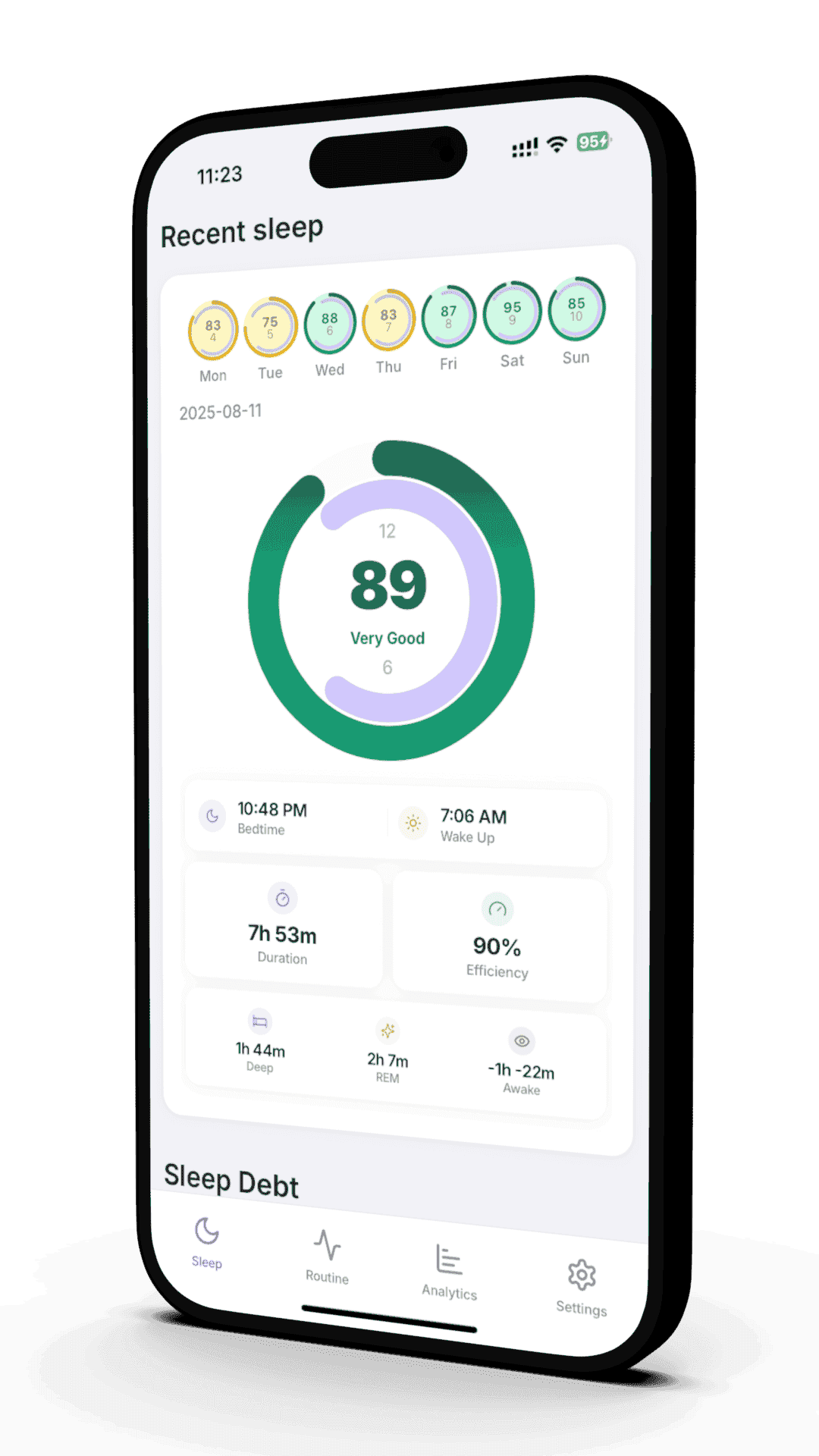
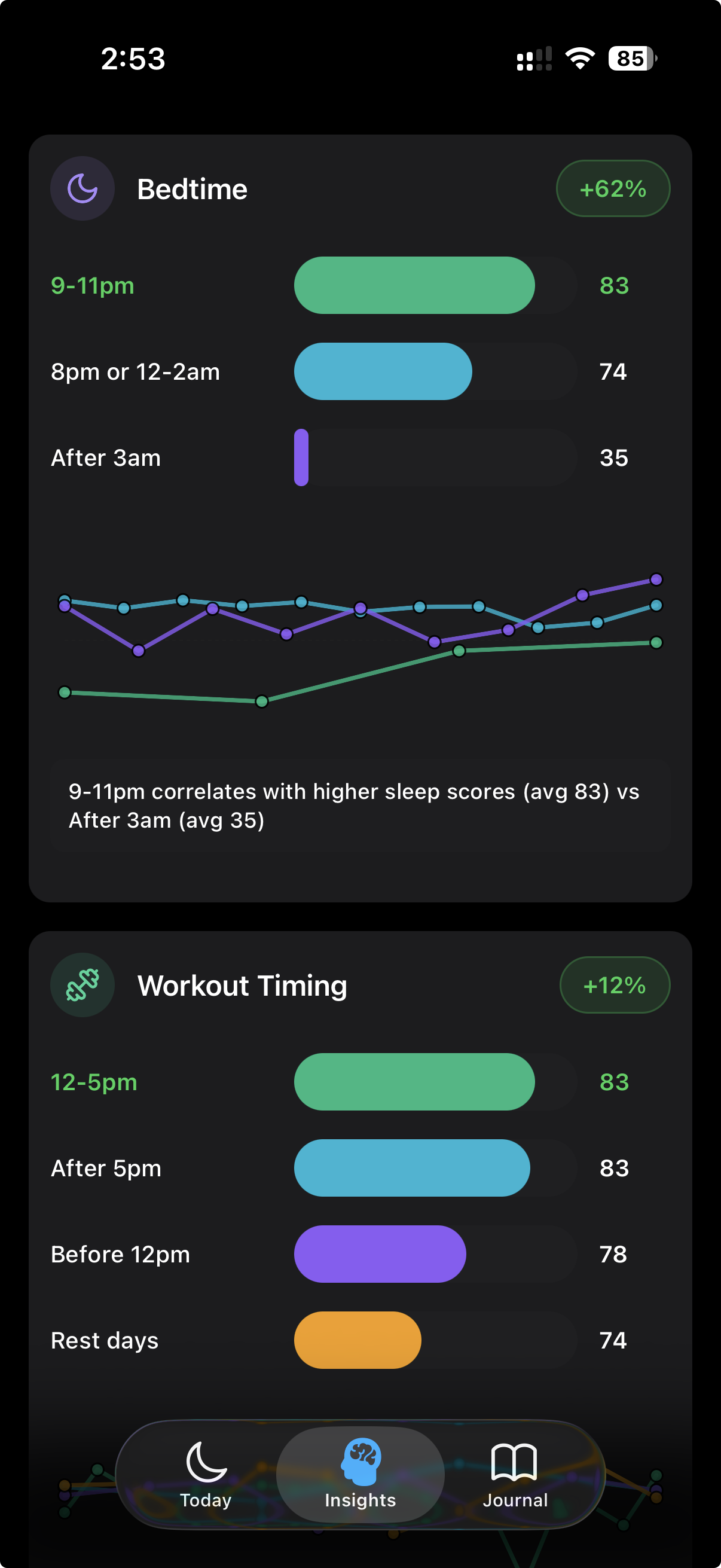
Reverie reads your Apple Watch sleep data and lets you tag habits — including noise machines, types of sound, and bedroom changes. Over a few weeks you can see whether your sleep score and time in deep sleep actually improve.
- • Tag white, pink, or brown noise nights
- • Compare sleep scores across sound types
- • See whether arousal counts drop with masking
- • Pair noise data with temperature, caffeine, and bedtime
References
- Papalambros NA, et al. "Acoustic Enhancement of Sleep Slow Oscillations and Concomitant Memory Improvement in Older Adults." Front Hum Neurosci. 2017;11:109. PubMed
- Riedy SM, Smith MG, Rocha S, Basner M. "Noise as a sleep aid: A systematic review." Sleep Med Rev. 2021;55:101385. PubMed
- Stanchina ML, Abu-Hijleh M, Chaudhry BK, Carlisle CC, Millman RP. "The influence of white noise on sleep in subjects exposed to ICU noise." Sleep Med. 2005;6(5):423-428. PubMed
- Papalambros NA, et al. "Pink Noise Boosts Deep Sleep in Mild Cognitive Impairment Patients." Northwestern Medicine. 2019. Source
- Hugh SC, et al. "Infant sleep machines and hazardous sound pressure levels." Pediatrics. 2014;133(4):677-681. PubMed
- Capezuti E, et al. "Systematic review: auditory stimulation and sleep." J Clin Sleep Med. 2022;18(6):1697-1709. PMC
Related Articles
Screen Time Before Bed
Phones, TVs, and tablets do more than emit blue light — what to actually watch for.
Sleep and Anxiety
Why anxiety wrecks sleep — and which tools actually break the cycle.
Test What Actually Helps You Sleep
Reverie tags habits and runs the comparison for you. See whether brown noise, white noise, or a quiet room actually moves your sleep score.
Free beta access. Shape the product. First to get updates. Requires Apple Watch.
Written by the Reverie Team
Based on sleep research and scientific studies