Screen Time Before Bed: What Actually Matters
The advice to stop using screens before bed is everywhere, and usually the reason given is blue light. The evidence tells a more interesting story: the content on your screen matters more than the light coming off it.
Key Insight: Scrolling social media for 30 minutes in bed delays sleep onset by 15-20 minutes — but the cause is emotional activation and opportunity cost, not primarily blue light. The content matters more than the screen.
The Real Problem With Phones at Night
Most articles about screens before bed focus on one thing: blue light suppresses melatonin, therefore phones disrupt sleep. This is partly true but misleading. A 2015 PNAS study by Chang and colleagues demonstrated that reading a light-emitting eReader for four hours before bed did suppress melatonin, delay circadian timing, and reduce morning alertness compared with reading a paper book. That finding is real, but it was measured under extreme conditions: four hours of bright screen exposure at close range with no other variables.
In everyday life, the dose of blue light from casually using a phone for 30 minutes in bed is a fraction of what daylight delivers in a single minute outside. What actually delays sleep onset and degrades sleep quality is not mainly the light — it is what the phone does to your nervous system.
The real culprits are three: sympathetic arousal from emotionally engaging content, dopamine release from unpredictable social feedback, and opportunity cost — the time you spend scrolling is time you could have been asleep. None of these are solved by night mode, warm-tone filters, or blue-light glasses.
Three Mechanisms That Actually Hurt Sleep
How Scrolling Shifts Your Physiology
Pick up your phone and open a news app. Within seconds your eyes dart across headlines, your brain begins evaluating threats, your heart rate nudges up by a few beats per minute. A tense video, a political post, an email that raises your pulse — all of these engage the sympathetic nervous system. Sleep onset requires the opposite: parasympathetic dominance, slowing heart rate, rising vagal tone.
Exelmans and Van den Bulck (2016) surveyed 844 adults and found that bedtime mobile phone use was associated with shorter sleep duration, worse sleep quality, longer sleep latency, and more daytime fatigue. The strongest predictor was not screen time in general but specifically phone use after getting into bed. When a phone followed someone under the covers, the effect size jumped.
A Saudi study by Rafique and colleagues (2020) looked at university students and found similar patterns: higher mobile phone use before bed predicted worse subjective sleep quality, even after controlling for caffeine, stress, and exercise. The relationship was dose-dependent — more phone time, worse sleep. Cortisol may also rise in response to stressful content, further delaying sleep onset.
In short: your phone is a heart-rate accelerator with a screen attached. What matters is not the wavelengths of light coming off the display but what the content is doing to your physiology.
Content Matters More Than the Device
Not all screen activities are equal. A comfort-show re-run on a TV across the room is nothing like doom-scrolling Twitter in bed. Calm content on a calm screen delays sleep far less than activating content on an intimate screen.
Low-Arousal
Rewatching a familiar sitcom, a calm audiobook, a slow podcast, an eReader in warm mode with a single paragraph per screen. These activities signal wind-down.
Medium-Arousal
A new show with cliffhangers, YouTube binges, a group chat that is active, a dating app. Engaging enough to push past sleepiness, mild enough to not trigger the stress response outright.
High-Arousal
Social media feeds, news apps, political content, horror, competitive games, work email. These produce real sympathetic activation. Expect a 20 to 45 minute cost to sleep onset.
Very High Arousal
Arguments in DMs, reading work emails that might require a response, checking news during a crisis. These can block sleep onset for over an hour and produce fragmented sleep once you do nod off.
Hale and Guan's 2015 systematic review of 67 studies found that TV viewing had weaker effects on sleep than interactive devices — phones and tablets — likely because interaction requires continual engagement and produces more arousal than passive watching. Gradisar and the National Sleep Foundation's 2013 report showed the same pattern: the more interactive the device, the worse the sleep impact.
Replacement Behaviors That Work
Telling people to stop using their phone before bed usually fails because the phone is filling a real need: decompression, stimulation, loneliness, ritual. You cannot just remove it — you have to replace it with something that satisfies the same need without the cost.
Replacements Ordered by Effectiveness
- Audiobooks with a sleep timer.A calm narrator and a 20-minute timer delivers stimulation and ends on its own. Works because sound occupies the mind without visual engagement.
- Paper book or Kindle in warm mode.Reading a physical book is the gold-standard replacement. A Kindle with warm lighting is a close second — single-purpose, no notifications, no feed.
- Calm podcasts at dim light.Long-form interviews, nature documentaries, history podcasts. Avoid news podcasts and anything with cliffhanger serial formats.
- A 15-minute wind-down routine.Shower, journal three lines, stretch, dim lights. The routine itself becomes a sleep cue.
- Phone out of bedroom.The hardest and most effective change. Charge the phone in the kitchen. Use a dedicated alarm clock. Remove the temptation entirely.
The 1-Hour Rule and Why It's Negotiable
Sleep-hygiene guides routinely recommend no screens for an hour before bed. For someone who reads a physical book at night already, this is easy. For most people, it is aspirational nonsense. A rule that is never followed is worse than a looser rule that actually gets used.
A more realistic approach: start with 30 minutes. For two weeks, replace the final 30 minutes before bed with a low-arousal activity — an audiobook, a paper book, a podcast on low volume. Track your sleep onset latency. If it drops, extend to 45 or 60 minutes. If it does not change much, your phone use was not the bottleneck and you can look elsewhere.
The rule also depends on content. If your last screen activity is watching a relaxed cooking show on a TV across the room, 15 minutes might be enough. If it is a heated group chat or a work email, 90 minutes might be too short. Treat the hour as a default, not a law.
The exception that matters: never bring the phone into bed. The evidence on this one specific behavior is the most consistent across studies. Once a phone is under the covers, sleep latency rises, total sleep drops, and quality falls. That single rule — phone stays on the nightstand or out of the bedroom entirely — delivers more benefit than any blue-light filter.
How Reverie Shows Screen Habits vs Sleep Quality
The reason screen-time advice fails is that it is generic. Your phone habits are not the same as anyone else's, and the effect on your sleep is specific to you. Some people can watch a crime drama and fall asleep in 10 minutes. Others lose half an hour of sleep from the same show.
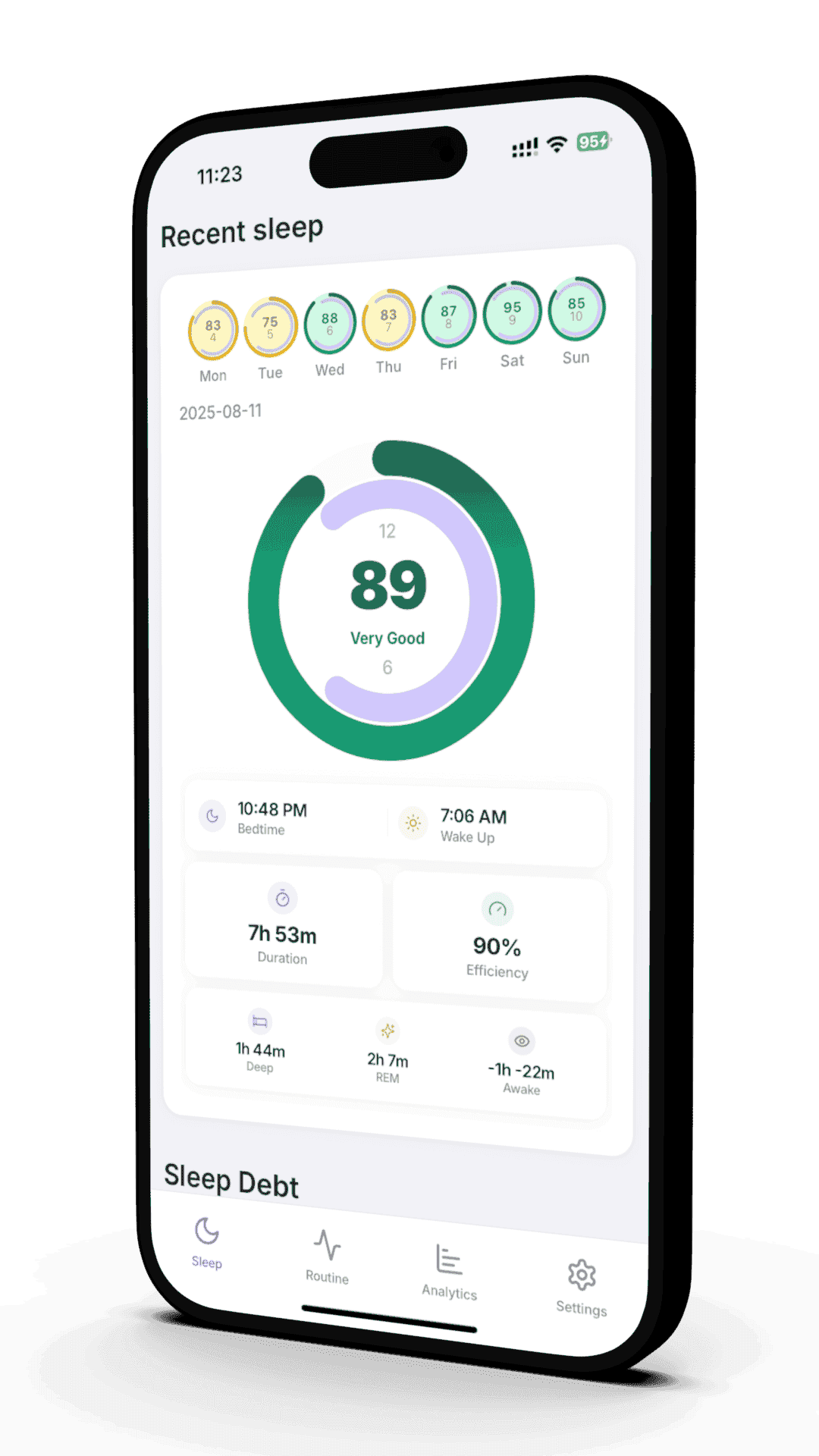
Reverie pulls your iOS Screen Time data alongside your Apple Watch sleep metrics. You can see week over week whether your 90-minute evening phone days correlate with lower efficiency, longer latency, and worse mood the next morning. You can filter by app category to see whether it is the social apps or the streaming apps that are costing you sleep.
What Reverie Correlates With Your Sleep
- • Evening Screen Time total minutes, broken out by hour
- • App category usage in the 2 hours before bed
- • Sleep onset latency paired with the previous evening's screen use
- • Sleep efficiency trends across high-screen and low-screen weeks
- • A personal threshold — how much evening phone time is too much, for you specifically
References
- Hale L, Guan S. "Screen time and sleep among school-aged children and adolescents: a systematic review." Sleep Med Rev. 2015;21:50-58. Source
- Exelmans L, Van den Bulck J. "Bedtime mobile phone use and sleep in adults." Soc Sci Med. 2016;148:93-101. Source
- Chang AM, Aeschbach D, Duffy JF, Czeisler CA. "Evening use of light-emitting eReaders negatively affects sleep, circadian timing, and next-morning alertness." Proc Natl Acad Sci USA. 2015;112(4):1232-1237. Source
- Rafique N, Al-Asoom LI, Alsunni AA, Saudagar FN, Almulhim L, Alkaltham G. "Effects of Mobile Use on Subjective Sleep Quality." Nat Sci Sleep. 2020;12:357-364. Source
- Gradisar M, et al. "The sleep and technology use of Americans: findings from the National Sleep Foundation's 2011 Sleep in America poll." J Clin Sleep Med. 2013;9(12):1291-1299. Source
Related Articles
Blue Light and Sleep
The narrower question of wavelengths — what blue light actually does to melatonin and circadian timing.
Sleep and Anxiety
Why phone-induced arousal is so damaging, and the CBT-I approach to re-associating the bed with sleep.
See Your Screen Habits Against Your Sleep
Join our beta program and watch how your evening screen time lines up with your sleep latency, efficiency, and morning mood. Reverie turns Apple Screen Time and Apple Watch data into one honest picture.
Free beta access. Shape the product. First to get updates. Requires Apple Watch.
Written by the Reverie Team
Based on sleep research and scientific studies