Sleep Chronotypes: Lion, Bear, Wolf, or Dolphin?
Some people pop out of bed at 5 a.m. ready to attack the day. Others can't form a sentence before 10 a.m. but write their best code at midnight. That isn't laziness or willpower. It's your chronotype — a biological setting baked into your circadian clock.
Key Insight: Roughly half of adults are intermediate chronotypes, with about 25 percent leaning morning and 25 percent leaning evening. Most jobs run on a morning-type schedule, which means most people are slightly out of sync with their own biology.
What a Chronotype Actually Is
Your chronotype is the natural timing of your circadian rhythm — the 24-hour clock that tells your body when to release cortisol, when to release melatonin, when to feel hungry, and when to feel sleepy. Two people in the same room can have circadian clocks that run hours apart from each other.
A big chunk of this is genetic. Researchers have linked chronotype to variants in clock genes like PER3, where a short tandem repeat (PER3-4) tends to track with evening preference and the longer version (PER3-5) with morning preference. The picture isn't simple — multiple genes are involved, and findings vary by population — but the takeaway is real: how early or late you feel "on" is partly written into your DNA.
Age and sex shift things too. Teenagers swing toward evening types during puberty — by 19 or 20, the average person is at their most owlish. From there, the curve slowly walks back toward earlier rising. Older adults swing toward morning types after age 60. Women tend to be slightly earlier types than men through most of adulthood, with the gap closing after menopause.
Light is the second giant input. Your brain's master clock sits in the suprachiasmatic nucleus, a tiny cluster of cells just above the optic nerve. It uses incoming morning light to keep the rest of the body's rhythms locked to the day. Less morning light means a clock that drifts later. More morning light means a clock that holds early. People who work night shifts or sit in dark offices push themselves toward evening preference whether they want to or not.
What Your Circadian Clock Controls
- • When melatonin starts rising in the evening
- • When your core body temperature hits its low point
- • When cortisol surges to wake you up
- • Your peak hours for focus, strength, and reaction time
- • Hunger, alertness, and mood across the day
The Academic Five-Type Model (MEQ)
The classic scientific tool for measuring chronotype is the Morningness-Eveningness Questionnaire, or MEQ, developed by Horne and Östberg in 1976. It's a 19-item self-report that scores you on a continuum.
The MEQ sorts people into five categories: definite morning, moderate morning, intermediate, moderate evening, and definite evening. The intermediate group is by far the largest. Extreme types at either end are rare.
A second instrument, the Munich ChronoType Questionnaire (MCTQ), was developed by Till Roenneberg in 2003. Instead of asking about preferences, it asks when you actually sleep on free days. Then it calculates your "midsleep on free days" — the midpoint between when you fall asleep and when you wake up on a day with no alarm. That number is the most objective chronotype measure we have.
The MCTQ has been used on more than 200,000 people. The results show a near-perfect bell curve: about 25 percent morning types, about 25 percent evening types, and roughly 50 percent in the middle. Extreme types sit out at the tails — true 4 a.m. risers and people whose natural midsleep is past 7 a.m. each make up just a few percent of the population.
A 2017 paper by Fischer and Roenneberg analyzed MCTQ data from over 50,000 Americans. The data showed that age moves chronotype dramatically: midsleep is around 5 a.m. at age 20, drifts to 4 a.m. by age 40, and lands closer to 3 a.m. by age 65. Sex effects are smaller but consistent. The takeaway is that chronotype isn't a fixed identity — it's a moving target, and the reasons for the move are biological, not lifestyle.
The Animal Model: Lion, Bear, Wolf, Dolphin
In 2016, sleep doctor Michael Breus rewrote the chronotype idea for a popular audience in his book The Power of When. He kept the science but swapped the dry labels for four animals that match how each type behaves.
The animal model maps onto the academic continuum like this — lions are the morning types, bears are the intermediates, wolves are the evening types, and dolphins are restless light sleepers who don't fit cleanly anywhere.
Lion (about 15 percent)
Wakes naturally between 5 and 6 a.m. Peak focus is the morning. Fades by mid-afternoon. In bed by 10 p.m. Lions thrive on the standard 9-to-5 schedule.
Best for: deep work before lunch, exercise early, light dinner.
Bear (about 50 percent)
Wakes between 7 and 8 a.m. Productive midmorning to midafternoon, with the classic post-lunch dip. Asleep by 11 p.m. Bears follow the sun.
Best for: meetings 10 a.m. to 12 p.m., creative work after lunch, exercise late afternoon.
Wolf (about 15 percent)
Doesn't truly wake up until 10 a.m. Two productivity peaks — around noon and again from 5 to 9 p.m. Bed at 12 a.m. or later. Hates early meetings.
Best for: creative or analytical work in the evening, late workouts, late meals.
Dolphin (about 10 percent)
Light, anxious sleepers. Hard to fall asleep, hard to stay asleep. Often perfectionists. Most productive between 10 a.m. and noon, then again briefly in late afternoon.
Best for: tight sleep hygiene, stable schedules, lower caffeine.
Breus's model is a simplification — the real continuum has no clean boundaries — but it's useful because it gives people a name for a pattern they already feel. If "I'm a wolf" helps you stop apologizing for not being sharp at 7 a.m., that's a win.
One word of caution: the dolphin category mixes biological tendency with insomnia, which are not the same thing. Chronic insomnia is a clinical diagnosis worth taking seriously. If you're a self-described dolphin who lies awake every night unable to switch off, that's not just a chronotype quirk — it's worth asking a doctor about.
Your Chronotype and Peak Performance Hours
Inside each chronotype, there's a predictable performance curve. Cognitive sharpness, reaction time, mood, and even physical strength rise and fall on the same daily schedule that drives your sleep timing.
Morning Types Peak Early
Lions hit peak alertness 2 to 4 hours after waking. By 3 p.m. they're past their best. Save analytical and high-stakes work for the morning. Use the late afternoon for routine tasks.
Intermediates Peak Late Morning
Bears do their sharpest thinking from about 10 a.m. to noon. Then comes the post-lunch dip — a real biological event, not just from the meal. Stack your hard meetings before lunch.
Evening Types Peak in the Evening
Wolves often have a small midday productivity window, then the real peak from 5 p.m. to 9 p.m. Their reaction time and creative output is best after sunset. The standard workday catches them at their worst.
Dolphins Peak in a Narrow Window
Dolphins have one short productivity peak in mid-morning, often after a slow start. They tend to feel a second wind in the early evening but should resist using it, since it can keep them up.
Social Jetlag: The Hidden Cost of a Bad Schedule Match
Roenneberg coined the term "social jetlag" for the gap between your biological sleep timing and your work-week sleep timing. If your body wants to fall asleep at 1 a.m. and wake up at 9 a.m. but your job forces a 6 a.m. alarm, you're flying from one time zone to another every Monday morning.
MCTQ studies show that more than two-thirds of people in industrialized societies have at least an hour of social jetlag. About a third have two hours or more. Wolves and late bears have it worst.
Social jetlag links to higher rates of obesity, depression, and cardiovascular risk in long-running studies — independent of total sleep time. Even when people get the same number of hours, the misalignment between biology and the alarm clock damages metabolic health.
The weekend rebound makes it worse. Sleeping in until noon on Saturday after a week of 6 a.m. wakes resets your clock later, which makes Monday harder. This is one of the strongest arguments for consistent sleep timing across the entire week.
The fix isn't to grind harder at the alarm clock. The fix is to narrow the gap between work-day timing and free-day timing. If your free-day midsleep is 5 a.m. and your work-day midsleep is 3 a.m., that two-hour gap is what your body fights every Monday. Shrinking that gap to 30 or 45 minutes — by going to bed slightly earlier on weekdays, or letting yourself sleep slightly later on weekdays if your job allows — is one of the most underrated sleep upgrades there is.
Can You Change Your Chronotype?
Mostly no. Your chronotype is shaped by genetics and age, and you can't argue with either. But you can shift it by 30 to 60 minutes in either direction with the right light exposure timing.
Light is the strongest signal your circadian clock receives. Bright morning light pulls your clock earlier — making you wake up earlier and feel sleepy earlier. Bright evening light pushes it later. This is the same mechanism behind jet lag recovery, just used on purpose.
If You Want an Earlier Schedule
- Get bright light within 30 minutes of waking.Sunlight outdoors is best. A 10,000 lux light box works on dark mornings.
- Dim the house in the evening.Cut overhead lights after 9 p.m. Use lamps and warm bulbs.
- Move bedtime 15 minutes earlier per week.Bigger jumps just don't stick.
- No caffeine after 2 p.m.It blocks the adenosine you need to feel sleepy at 10 p.m.
The reverse playbook works for owls who can't avoid early starts but want to ease the pain — minimize evening light, but accept that pulling a hardcore wolf into a 6 a.m. lion schedule is a permanent uphill battle. Better to negotiate a later start at work if you can.
Using Chronotype with Sleep Tracking
Sleep trackers don't usually label your chronotype, but they collect everything you need to figure it out. Look at your tracking data on free days — weekends or vacations, when no alarm goes off. The midpoint between when you actually fell asleep and when you actually woke up is your natural midsleep. Earlier than 3 a.m. and you're a lion. Around 4 to 4:30 a.m. you're a bear. Later than 5 a.m. and you're a wolf.
Once you know your type, the sleep score makes more sense. A wolf going to bed at 11 p.m. is fighting biology — they will lie awake. A lion forcing themselves to stay up for a midnight movie loses far more sleep than they realize. Both end up with accumulated sleep debt, just from different directions.
How Reverie Uses Your Chronotype
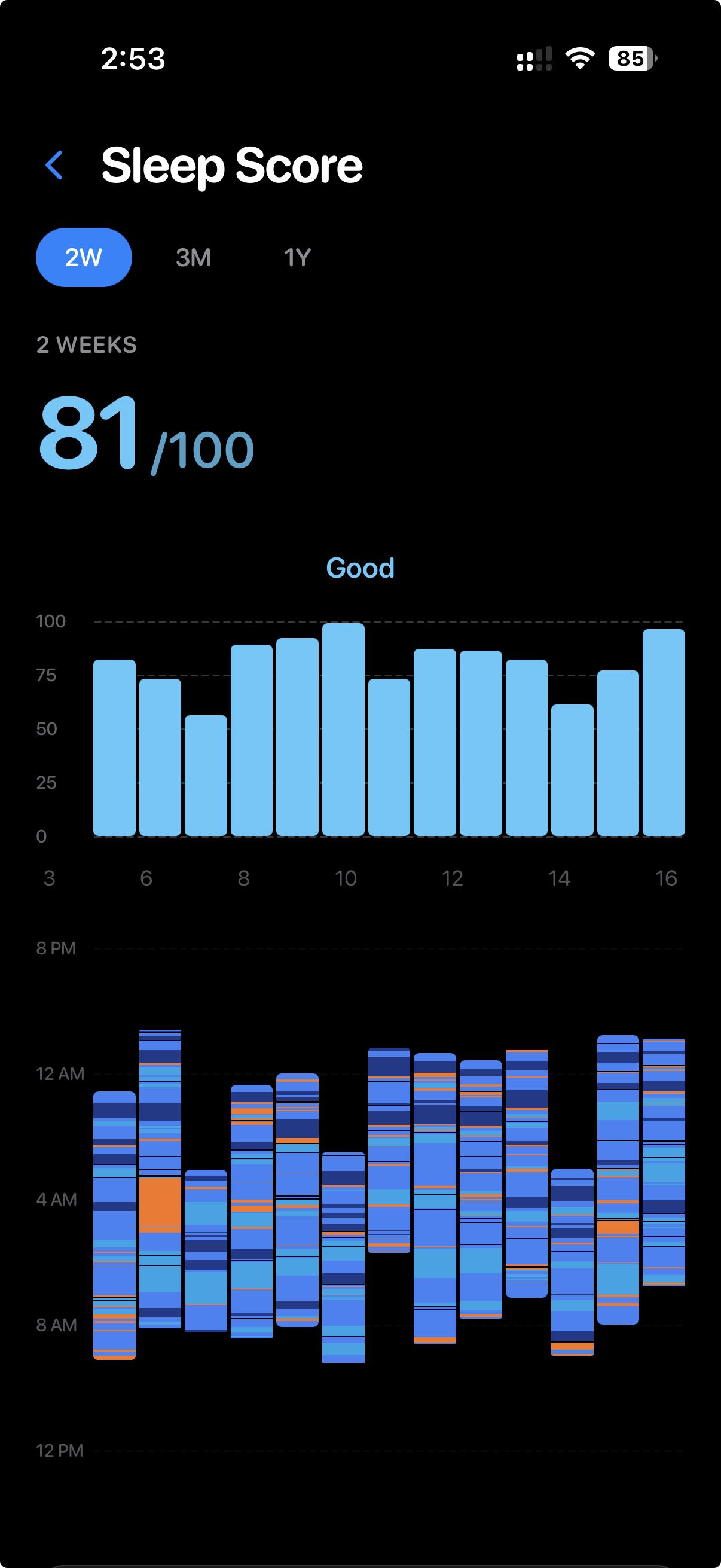
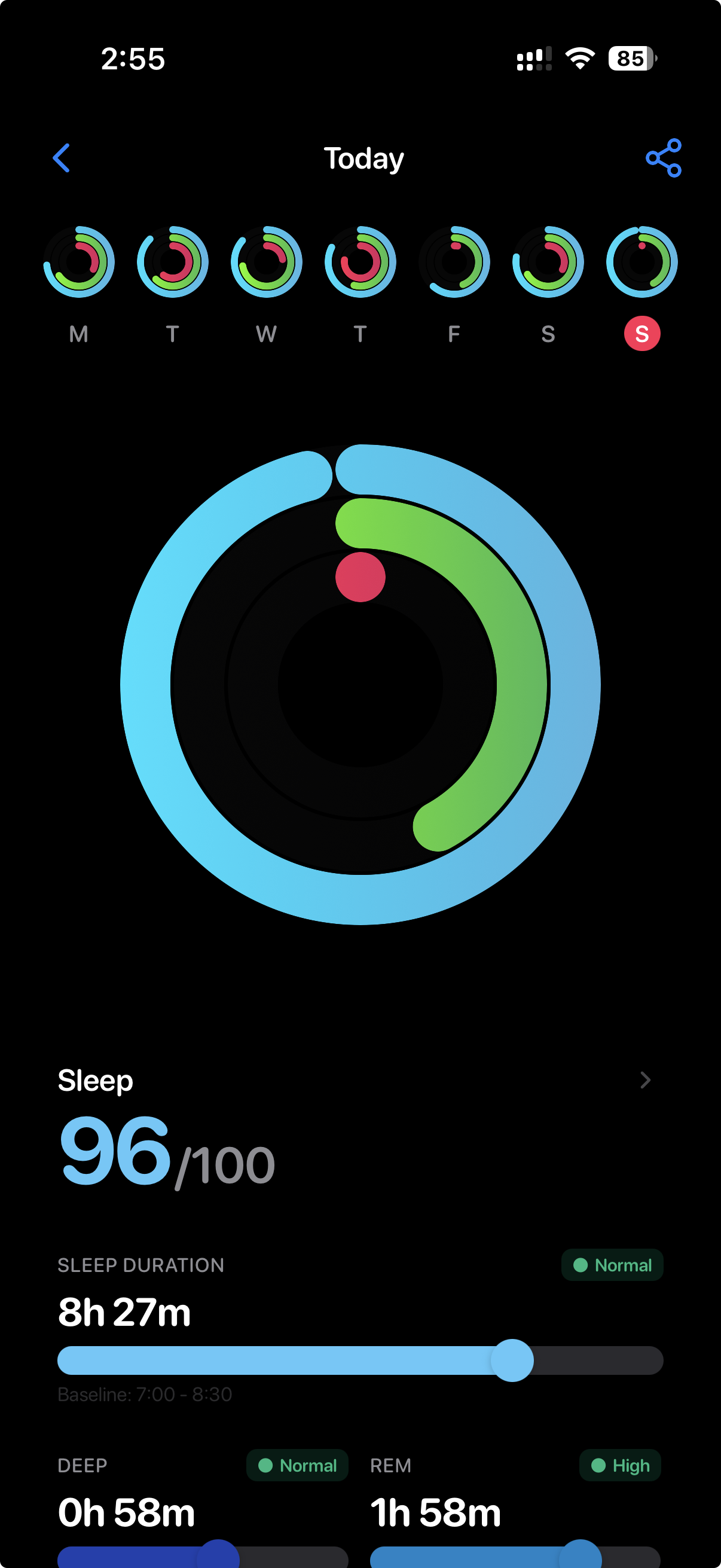
Reverie pulls your Apple Watch sleep data and looks at when you fall asleep on free days versus work days. It surfaces your natural sleep window and flags how much social jetlag you carry through the week.
- • Visualize your free-day vs work-day midsleep
- • See how big your social jetlag gap really is
- • Get habit suggestions tuned to your chronotype
- • Track whether light exposure changes shift your timing
References
- Horne JA, Östberg O. "A self-assessment questionnaire to determine morningness-eveningness in human circadian rhythms." Int J Chronobiol. 1976;4(2):97-110. PubMed
- Roenneberg T, Wirz-Justice A, Merrow M. "Life between clocks: daily temporal patterns of human chronotypes." J Biol Rhythms. 2003;18(1):80-90. Source
- Roenneberg T, et al. "Epidemiology of the human circadian clock." Sleep Med Rev. 2007;11(6):429-438. PubMed
- Fischer D, Lombardi DA, Marucci-Wellman H, Roenneberg T. "Chronotypes in the US — Influence of age and sex." PLoS One. 2017;12(6):e0178782. PMC
- Lázár AS, et al. "Sleep, diurnal preference, health, and psychological well-being: a prospective single-allelic-variation study." Chronobiol Int. 2012;29(2):131-146. PubMed
- Breus MJ. The Power of When: Discover Your Chronotype. Little, Brown Spark. 2016. Source
Related Articles
The Power of Sleep Consistency
Why hitting the same bedtime every night beats sleeping longer once a week.
How to Beat Jet Lag
The same light tools that shift your chronotype also fix jet lag fast.
Find Your Natural Sleep Window
Reverie reads your Apple Watch sleep data and helps you spot your real chronotype. See how big your social jetlag is and design a schedule your body actually wants.
Free beta access. Shape the product. First to get updates. Requires Apple Watch.
Written by the Reverie Team
Based on sleep research and scientific studies