How to Beat Jet Lag: A Science-Based Recovery Guide
Jet lag is not simply tiredness after a long flight. It is a biological conflict: your internal clock thinks it is one time, the sun outside says another, and every organ in your body has to renegotiate who is right. The good news is that the renegotiation is faster if you know which levers to pull.
Key Insight: Jet lag is a mismatch between your internal clock and local time. Eastbound (losing hours) is harder than westbound because your circadian clock naturally runs slightly longer than 24 hours. Light is the most powerful reset tool you have.
What Jet Lag Actually Is
Your circadian system is not a single clock. The master pacemaker sits in a tiny region of the hypothalamus called the suprachiasmatic nucleus (SCN), which takes its primary cue from light hitting the retina. But every organ — your liver, gut, heart, muscles, and immune cells — carries its own peripheral clock. These clocks normally stay synchronized through signals from the SCN, meal timing, temperature, and activity.
When you cross multiple time zones in a single day, the SCN and peripheral clocks do not update instantly. The SCN shifts at roughly one hour per day under natural conditions. Peripheral clocks drift at their own rate, usually slower for the liver and faster for the muscles. The result is a system where different parts of your body are on different time zones simultaneously.
The felt symptoms — insomnia at the new local night, daytime grogginess, irritability, brain fog, gut disruption, and appetite confusion — are all signatures of this internal disagreement. The standard rule is that natural recovery takes about one day per time zone crossed.
Common Jet Lag Symptoms
Why Eastbound Is Harder
Flying east feels worse than flying west, and that is not in your head. The human circadian clock has a natural free-running period of roughly 24.2 hours, meaning that without any external cues, your body drifts slightly later every day. This is why staying up late is easier than going to bed early, and why sleeping in is easier than waking earlier.
Westbound travel asks you to extend your day — stay awake longer and go to bed later at the destination. This is called a phase delay. Your biology cooperates because it is already drifting in that direction. Eastbound travel asks you to shrink your day and wake up earlier — a phase advance. Your biology resists.
The practical implication: crossing six time zones eastward often takes noticeably longer to recover from than six time zones westward. Plans for protocols, light timing, and melatonin all depend on the direction of travel.
Light: The Master Reset
Nothing shifts your circadian clock as powerfully as light. It is stronger than melatonin, stronger than sleep timing, and stronger than meal schedules. Bright light in the morning advances your clock (makes you want to sleep earlier). Bright light in the evening delays your clock (makes you want to sleep later). Getting the timing right is the entire game.
The critical concept is your core body temperature minimum, which usually falls around 2 hours before your habitual wake time. Light received before this minimum delays your clock. Light received after it advances your clock. When you travel, your temperature minimum is still on home time for the first few days, and you need to plan light exposure accordingly.
For eastbound travel (for example New York to London), you want to advance your clock. Seek bright light in the destination morning and avoid it in the destination evening. Sunglasses or an eye mask during the early destination morning of day one, then aggressive morning sun starting day two, tends to work well.
For westbound travel (for example London to Los Angeles), you want to delay your clock. Seek bright light in the destination afternoon and early evening. Go outside at sunset. This pushes your clock in the direction your biology already wants to go.
Melatonin for Time Zone Shifts
Melatonin is the one supplement with strong evidence specifically for jet lag. A Cochrane review of ten trials concluded that melatonin is effective and safe for reducing jet lag symptoms after travel across five or more time zones, especially when flying east. It is not a sleeping pill — it works by signaling the brain that darkness has arrived.
The dose that works is smaller than most people take. Clinical research points to 0.5 mg as the physiological dose that mimics your body's own evening melatonin release. Larger doses (3 to 5 mg) are not more effective and can cause grogginess the following day.
The timing is what matters most. Take 0.5 mg roughly 30 to 60 minutes before your target bedtime at the destination, for the first 3 to 5 nights. If you are traveling east and really struggling to fall asleep, you can take it slightly earlier. Pair the dose with dim light and a cool room. Skipping it once your clock has adjusted is fine.
Low Dose Is Intentional
0.5 mg is close to what your own pineal gland releases. High doses saturate melatonin receptors and can blunt the next night's natural release.
It Works Best With Light
Melatonin alone produces a modest shift. Melatonin plus correctly timed morning light at the destination produces the largest combined shift in clinical trials.
Meal Timing and Exercise
The peripheral clocks in your liver, gut, and muscles listen to signals that the SCN cannot override: when you eat and when you move. Aligning these behavioral signals to the new time zone helps the peripheral clocks catch up with the master clock, reducing the lingering "off" feeling that can persist after you are sleeping correctly.
On the day of arrival, eat your next meal at the destination time that matches breakfast, lunch, or dinner — whichever is closest. Even if you are not hungry, a small meal anchors your gut clock. Avoid heavy meals at home-body-time night, which tend to disrupt sleep and reinforce the old schedule.
Morning exercise at the destination is a strong circadian cue. A 20- to 30-minute walk outdoors in daylight after landing can produce a combined light-plus-activity signal that hits both the SCN and peripheral clocks at once. Heavy exercise late in the destination evening can delay the clock unhelpfully, so save harder sessions for the morning.
Some travelers use a short fast during the flight (roughly 12 to 16 hours) and then break it with the first meal at the destination breakfast time. The evidence is mixed, but it costs little and many find it useful.
Practical Pre-Flight and In-Flight Strategy
The most effective jet lag protocol starts before you board the plane. Research by Burgess, Eastman, and colleagues showed that advancing your sleep schedule by one hour per day for three days before an eastbound flight, combined with morning bright light, can shift your circadian phase enough to skip much of the worst jet lag on arrival.
Travel Day Protocol
- Pre-flight (3 days out).Shift bed and wake times by 1 hour per day in the direction of travel. Add morning light for eastbound, evening light for westbound.
- Set your watch on boarding.Mentally switch to destination time. Eat and sleep only according to that schedule.
- Sleep on overnight flights.Use an eye mask, noise cancelling, and a small pillow. Skip caffeine on board. Melatonin 30 minutes before destination bedtime.
- Stay aggressively hydrated.Cabin air is dry and dehydration amplifies every jet lag symptom. A liter of water per 4 hours is not too much.
- Stay awake on arrival.If you land in daylight, do not take a long nap. A 20-minute nap is fine; anything longer cements the old schedule.
How Reverie Tracks Your Recovery
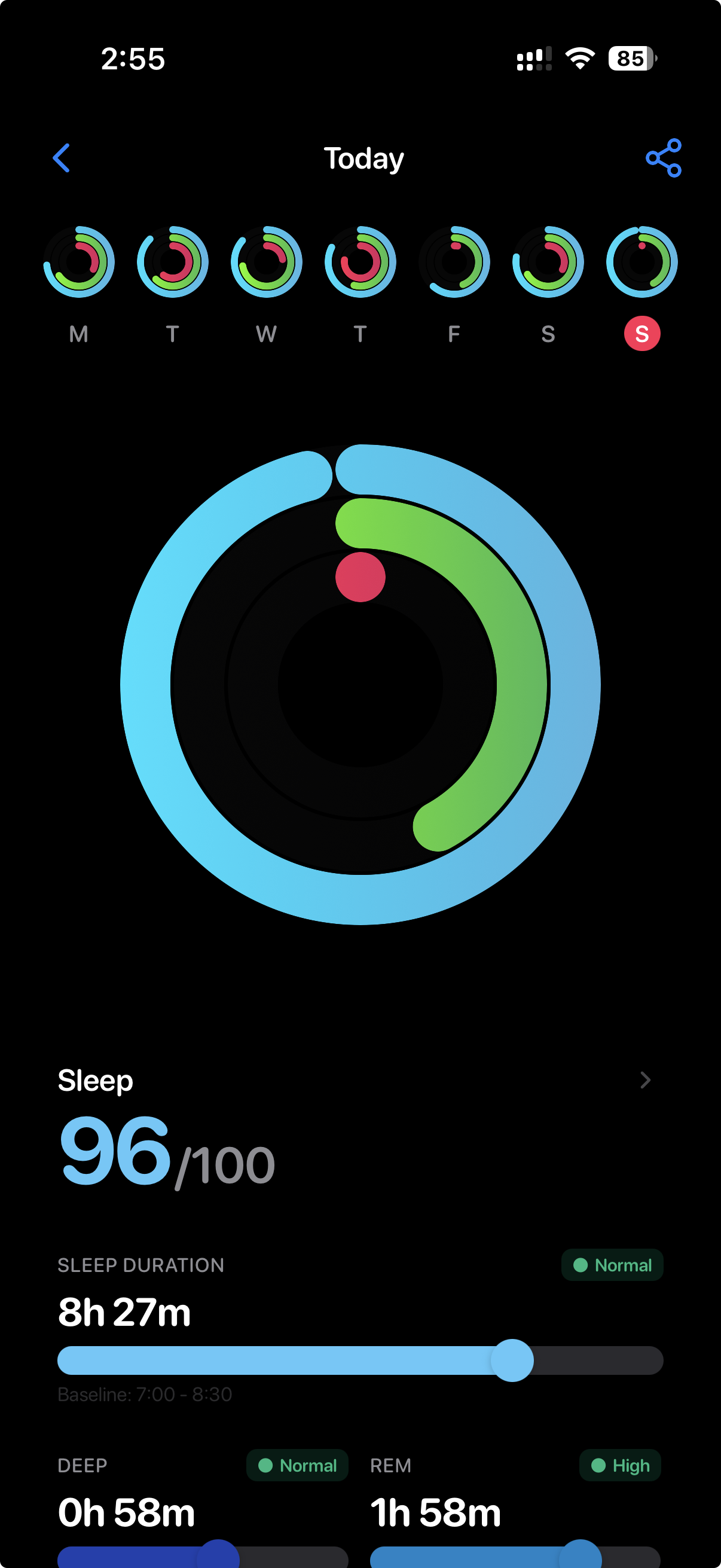
When your circadian rhythm shifts, the evidence shows up in your Apple Watch data. Your resting heart rate climbs for a few days. Your HRV drops. Your sleep timing jumps forward or back, and your sleep efficiency usually dips for several nights before recovering. Watching these signals lets you see the shift objectively and confirm when you have actually recovered.
Apple Health stores all of this raw data, but it does not show you the recovery curve. Reverie reads your sleep, heart, and activity data and plots your jet lag recovery against your pre-trip baseline. You can see the day your patterns return to normal rather than guessing from how you feel.
How Reverie Helps You Travel Better
Reverie turns your Apple Watch data into a readable recovery timeline so you can see how many days a given trip actually costs you, and how your protocol is working.
- • See your sleep midpoint shift across the first week
- • Watch HRV and resting heart rate normalize over time
- • Compare eastbound versus westbound recovery for the same traveler
- • Use a sleep score that accounts for travel disruption
References
- Eastman CI, Burgess HJ. "How To Travel the World Without Jet Lag." Sleep Med Clin. 2009;4(2):241-255. Source
- Herxheimer A, Petrie KJ. "Melatonin for the prevention and treatment of jet lag." Cochrane Database Syst Rev. 2002;(2):CD001520. Source
- Sack RL. "Clinical practice. Jet lag." N Engl J Med. 2010;362(5):440-447. Source
- Burgess HJ, Crowley SJ, Gazda CJ, Fogg LF, Eastman CI. "Preflight adjustment to eastward travel: 3 days of advancing sleep with and without morning bright light." J Biol Rhythms. 2003;18(4):318-328. Source
- Arendt J. "Managing jet lag: Some of the problems and possible new solutions." Sleep Med Rev. 2009;13(4):249-256. Source
Related Articles
Melatonin Supplements: What Works
Dose, timing, and what melatonin actually does in your brain.
The Power of Sleep Consistency
Why a steady schedule beats a long schedule for almost every health marker.
Track Your Recovery After Every Trip
Join our beta program and see the real cost of each trip. Reverie turns your Apple Watch data into a jet-lag recovery map that shows exactly when you are back on schedule.
Free beta access. Shape the product. First to get updates. Requires Apple Watch.
Written by the Reverie Team
Based on sleep research and scientific studies