The 90-Minute Sleep Cycle: How It Works and Why It Matters
Sleep is not a single uniform state. Your brain moves through a repeating 90-minute pattern all night, and whether you wake up refreshed or groggy depends largely on where you were in that pattern when your alarm went off.
Key Insight: A typical adult runs through 4 to 6 sleep cycles per night. The first cycles are deep-sleep heavy; the last cycles are REM heavy. Both halves matter — and they serve different purposes.
What Is a Sleep Cycle?
A sleep cycle is one full pass through the four stages of sleep: N1 (light transition), N2 (core sleep), N3 (deep sleep), and REM. The cycle lasts roughly 90 minutes in healthy adults, though it can range from 70 to 120 minutes depending on the person and where you are in the night.
The 90-minute pattern is an example of an ultradian rhythm — a biological rhythm shorter than 24 hours. It is driven by oscillating activity in the brainstem, specifically in regions that regulate arousal and neurotransmitter release. When you fall asleep, that machinery turns on and starts cycling.
Each cycle is not a clean repetition of the one before it. The mix of stages inside each cycle changes as the night goes on. Your first cycle is heavy on deep sleep. Your last cycle is almost entirely light sleep and REM. This shift is just as important as the cycles themselves.
The Four Stages Inside One Cycle
How the Cycles Shift Across the Night
The standard picture of a sleep cycle — 5 minutes of N1, 25 minutes of N2, 30 minutes of N3, 30 minutes of REM — is misleading because it suggests every cycle looks the same. In reality, the mix changes dramatically from your first cycle to your last.
Cycles 1 and 2 (the first 3 hours of sleep): Heavy on deep sleep. Your first REM period is often just 5 to 10 minutes. Your body does most of its physical repair work here — growth hormone release, immune function, tissue repair.
Cycles 3 and 4 (hours 3 to 6): Deep sleep shrinks. REM starts to grow. Your body has done most of its physical restoration and is beginning its cognitive work.
Cycles 5 and 6 (hours 6 to 9): Almost no deep sleep. REM episodes can last 30 to 60 minutes each. This is when your brain consolidates memory, integrates new learning with old, and processes emotions.
Why Full Cycles Matter
The case for protecting full cycles comes down to two things: grogginess on waking, and the lopsided distribution of deep sleep and REM.
Sleep Inertia
Waking up in the middle of deep sleep produces sleep inertia — that disoriented, heavy-headed state that can last 15 to 30 minutes. Waking up at the end of a cycle, during light sleep, is far easier and feels almost instant. If your alarm goes off in the middle of a deep-sleep phase, you will feel worse than if you had slept an hour less and woken at a cycle boundary.
Deep Sleep Is Front-Loaded
Because deep sleep dominates the first cycles, you can lose the final 2 hours of sleep and still keep 80 percent of your deep sleep. This is a survival feature — the brain prioritizes physical restoration early, in case you need to wake up and run.
REM Is Back-Loaded
The opposite is true for REM. Cutting the last 2 hours of an 8-hour night can remove 40 to 50 percent of your REM sleep. People who routinely sleep 6 hours instead of 8 are not just short on sleep — they are specifically short on REM, which is why chronic short sleepers often report problems with memory, mood, and creative thinking.
The Middle Cycles Do Dual Work
Cycles 3 and 4 matter because they contain meaningful amounts of both deep sleep and REM. Skipping them means losing the transition where your brain balances physical recovery with cognitive work. Most people who chronically sleep only 5 to 6 hours are missing these middle cycles entirely.
What Disrupts Sleep Cycles
The 90-minute rhythm is surprisingly fragile. Small disruptions can fragment cycles and prevent you from getting the full repair-then-integrate sequence your brain is trying to run.
Waking During Deep Sleep
A phone notification or a partner's movement during deep sleep forces you back to N2 or N1. Your next cycle may skip REM entirely. One disruption can cost you 15 to 30 minutes of sleep architecture.
Alcohol
Alcohol blocks REM in the first half of the night and causes REM rebound with fragmented, shallow cycles in the second half. Even moderate drinking changes the shape of your entire night.
Sleep Apnea
Breathing pauses trigger micro-arousals that fragment sleep. Severe apnea can prevent someone from ever entering stable N3 or REM, even during a full night in bed.
Irregular Sleep Schedule
Your circadian rhythm coordinates with your cycles. Going to bed at inconsistent times means your body never knows when to deliver the REM-heavy final cycles.
How to Get Full Sleep Cycles
You cannot force a specific cycle length — it is an involuntary process — but you can create the conditions that let cycles complete cleanly.
Strategies That Protect Cycles
- Plan sleep in 90-minute blocks.If you cannot sleep 8 hours, aim for 7.5 (5 cycles) or 6 (4 cycles) rather than 7 hours, which is likely to leave you mid-cycle.
- Protect the first 3 hours.This is where your deep sleep happens. No caffeine after 2 PM, no late workouts, and a cool quiet room to support the first two cycles.
- Protect the last 2 hours.This is your REM-heavy window. Avoid alcohol in the evening, which specifically destroys late-night REM.
- Silence notifications.Use Do Not Disturb or airplane mode. One notification in the middle of a cycle can fragment the remainder of your night.
- Use a smart wake window.Some apps, including Apple's sleep features, can wake you during the light-sleep portion of a cycle within a 30-minute window of your alarm. This avoids the grogginess of a mid-cycle alarm.
How Apple Watch Tracks Your Cycles
Apple Watch Series 4 and later, running watchOS 9 or newer, estimates your sleep stages throughout the night and can reconstruct the shape of each cycle. Looking at your sleep timeline in the Health app, you can see the rising and falling waves of deep sleep and REM across the night. Healthy sleep produces a recognizable pattern — deep-sleep heavy early, REM-rich later.
Apple Health shows you the raw data but does not help you interpret it. If your cycles look fragmented, or if you are missing the late-night REM blocks, Apple Health will not tell you why.
How Reverie Reads Your Cycles
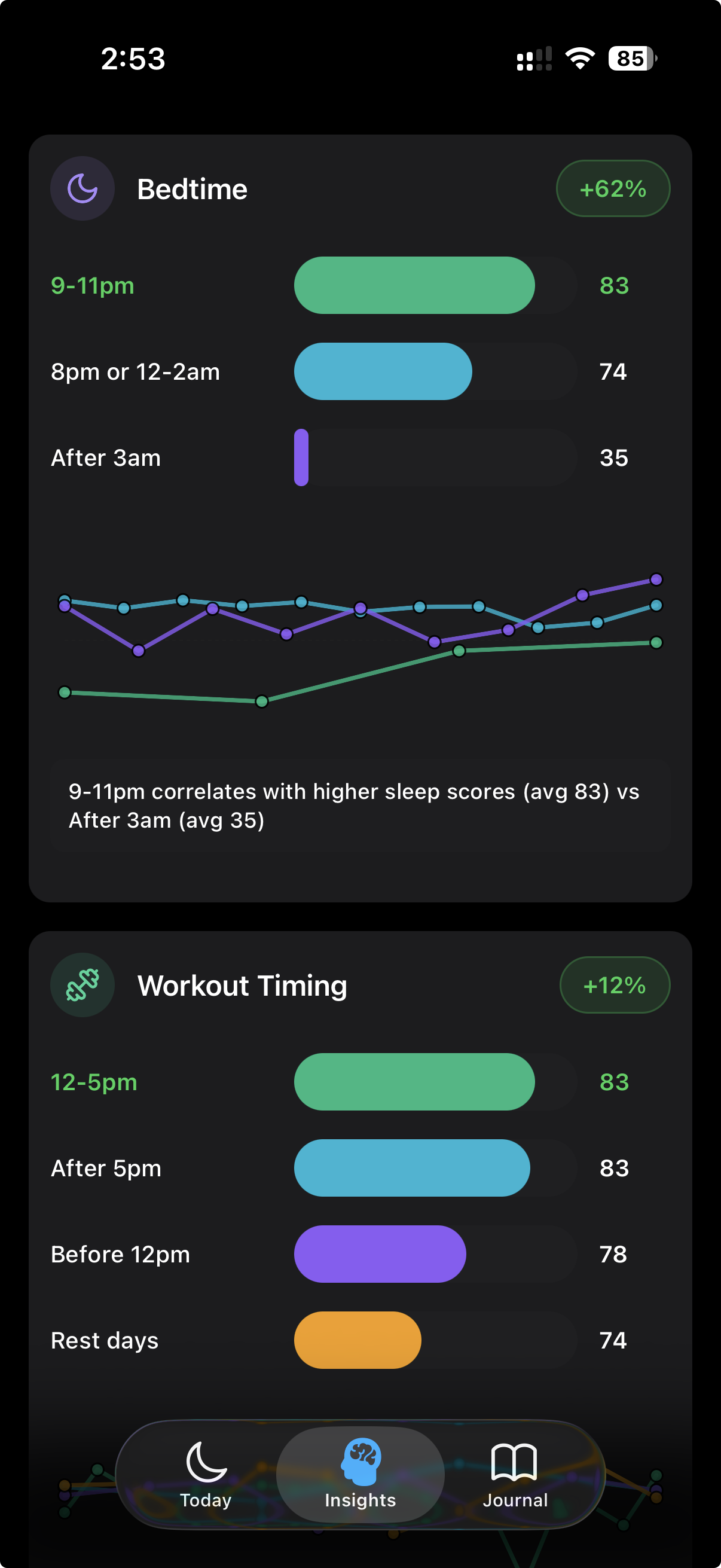
Reverie turns your Apple Watch sleep data into a readable cycle map. You can see how many complete cycles you ran, how the ratio of deep to REM shifted across the night, and which habits are producing your best and worst nights.
- • Visualize every cycle with deep, light, and REM segments
- • Spot fragmented nights and their causes
- • Compare nights of 4, 5, and 6 completed cycles
- • Get a sleep score that rewards complete cycles, not just duration
References
- Carskadon MA, Dement WC. "Normal Human Sleep: An Overview." In: Principles and Practice of Sleep Medicine, 5th ed. 2011:16-26. Source
- Feinberg I, Floyd TC. "Systematic trends across the night in human sleep cycles." Psychophysiology. 1979;16(3):283-291. Source
- Tassi P, Muzet A. "Sleep inertia." Sleep Medicine Reviews. 2000;4(4):341-353. Source
- Dijk DJ, Czeisler CA. "Contribution of the circadian pacemaker and the sleep homeostat to sleep propensity, sleep structure, EEG slow waves, and sleep spindle activity in humans." J Neurosci. 1995;15(5 Pt 1):3526-3538. Source
- Ebrahim IO, et al. "Alcohol and sleep I: effects on normal sleep." Alcohol Clin Exp Res. 2013;37(4):539-549. Source
Related Articles
REM Sleep Explained
A deep dive into the REM stage of each cycle and why it's so important.
How Much Deep Sleep Do You Need?
The slow-wave half of the cycle — how much you need and how to protect it.
See Your Own Sleep Cycles
Join our beta program and see exactly how your cycles unfold each night. Reverie turns your Apple Watch data into a readable cycle map with habit context.
Free beta access. Shape the product. First to get updates. Requires Apple Watch.
Written by the Reverie Team
Based on sleep research and scientific studies