Alcohol and Sleep: Why a Nightcap Wrecks Your REM
A glass of wine after dinner feels relaxing. A beer after work feels like it helps you unwind. But the sedation alcohol produces is not the same as sleep, and by the time the alcohol has left your bloodstream, the damage to your night is already done.
Key Insight: Even 1 to 2 drinks within 3 hours of bedtime can reduce REM sleep by 24 to 30 percent. Alcohol blocks REM most severely in the first half of the night, causing REM rebound with vivid dreams, night sweats, and early waking in the second half.
What Alcohol Does to Your Sleep Architecture
Alcohol is a central nervous system depressant. Within 20 minutes of a drink, ethanol binds to GABA receptors in your brain — the same receptor family that benzodiazepines and sleeping pills target. GABA is your brain's primary inhibitory neurotransmitter, and when alcohol amplifies its signal, neurons fire less, muscles relax, and you feel drowsy. This is why you fall asleep faster after drinking. On average, sleep onset latency drops by about 15 to 20 minutes.
But sedation is not sleep. True sleep is an active, orchestrated process where your brain cycles through light, deep, and REM stages in a specific sequence. Alcohol-induced sedation is a blunt chemical override. The brain is forced into a state that looks superficially like sleep but lacks the normal architecture.
The most obvious casualty is REM sleep. Alcohol suppresses REM by interfering with the brainstem nuclei that turn REM on — particularly the pontine tegmentum, where acetylcholine surges normally trigger dreaming. With those signals blunted, you spend less time in REM and more time in shallow N2 sleep, where the brain does little of its cognitive repair work.
What Changes Inside Your Brain After a Drink
The Two-Phase Disruption
Alcohol does not disrupt your night evenly. It produces two distinct, opposite phases — a sedated first half and a wrecked second half. Understanding this split is the key to understanding why you can sleep a full 8 hours after drinking and still feel destroyed the next day.
First half (hours 0 to 4): Your body is still metabolizing ethanol at roughly one drink per hour. GABA is amplified, REM is suppressed, and you are essentially sedated. Deep sleep actually increases slightly in this window — this is why people feel like alcohol “knocks them out.” But the deep sleep is disorganized, and REM is either delayed or skipped entirely.
Second half (hours 4 to 8): Once the alcohol is metabolized, your brain rebounds. The REM you were denied tries to happen all at once. You enter long, intense REM periods that produce vivid, sometimes disturbing dreams. Cortisol surges around 3 to 4 AM. Heart rate rises. You wake up repeatedly — sometimes fully, sometimes in micro-arousals you will not remember.
This two-phase pattern is why a nightcap feels like it works when you track how fast you fell asleep, but looks terrible when you look at a full hypnogram. The structure of your night has been inverted: deep sleep where REM should be, fragmented wakefulness where deep sleep should be.
How Much Is Too Much?
The dose response here is sharper than most people realize. A 2018 study of more than 4,000 nights from Finnish employees, using heart rate variability as a proxy for recovery, produced the cleanest numbers we have.
1 Drink — 9% Drop in Sleep Quality
Even a single glass of wine measurably lowers nighttime heart rate variability and reduces autonomic recovery. The effect is subtle, but it is real, and it is not zero. If you drink every night, that 9 percent compounds into a pattern of chronically under-recovered sleep.
2 Drinks — 24% Drop in Sleep Quality
Two drinks — roughly what most people consider a normal evening — nearly triple the impact of one. This is where REM suppression becomes obvious, where most people start waking up at 3 AM, and where morning heart rate is noticeably elevated.
3+ Drinks — 40% Drop in Sleep Quality
At three or more drinks, the disruption is severe. REM can be cut by a third or more, deep sleep becomes fragmented, and recovery metrics resemble a night of severe sleep deprivation. Weekly heavy drinkers often run a permanent sleep debt without realizing alcohol is the cause.
Individual Variation
Body weight, sex, genetics, and tolerance all shift these numbers. Women metabolize alcohol more slowly on average. Older adults see larger REM suppression at lower doses. There is no safe universal threshold, but the curve is consistent: more alcohol, worse sleep, every time.
Why You Feel Terrible Even After 8 Hours
The mystery of the 8-hour hangover — you went to bed at 10 PM, you did not wake up until 6 AM, and you feel like you slept 4 hours — is fully explained by what alcohol does to sleep architecture. Hours in bed is not the same as restorative sleep.
Fragmented Architecture
You got time in bed but not time in the right stages. REM was suppressed early and crammed into the last hours. Deep sleep was disorganized. Your brain did not complete its normal repair sequence, so you wake up cognitively under-recovered.
Dehydration
Alcohol suppresses vasopressin, the hormone that tells your kidneys to hold onto water. You lose more fluid than you take in. Dehydration lowers blood volume, raises heart rate, and produces the pounding-head, cotton-mouth morning feeling even when you only had two drinks.
The 3 AM Cortisol Spike
As alcohol clears, your hypothalamus releases cortisol earlier and more aggressively than normal. This is why so many people wake at 3 or 4 AM after drinking, heart racing, unable to fall back asleep. It is a measurable endocrine event, not anxiety.
Airway Relaxation
Alcohol relaxes the muscles of the throat, increasing snoring and obstructive breathing events. People who have mild sleep apnea often have a full-blown apnea episode after drinking, dropping oxygen saturation repeatedly through the first half of the night.
How Long Before Bed Should You Stop?
The body metabolizes alcohol at a near-constant rate of roughly one standard drink per hour for an average adult. A “standard drink” is 12 ounces of beer, 5 ounces of wine, or 1.5 ounces of spirits. Smaller people, women on average, and people taking certain medications metabolize slower.
If your goal is to protect REM and deep sleep, the rule is simple: your blood alcohol concentration needs to be at or near zero when you fall asleep. That means finishing your last drink at least one hour before bed per drink consumed, plus a buffer.
Strategies That Protect Your Sleep
- Finish drinks 3 to 4 hours before bed.This gives most bodies enough time to fully clear two standard drinks. It is the single change with the biggest impact on REM.
- Stop at one drink on work nights.A single drink finished with dinner produces a measurable but small hit to sleep quality. Two or more on a weekday adds up fast.
- Match every drink with water.Hydration will not rescue REM, but it will blunt the cortisol spike and the dehydration-driven morning headache.
- Avoid alcohol as a sleep aid.If you drink to fall asleep, you are trading faster sleep onset for a fragmented second half of the night. The net effect is less restorative sleep, not more.
- Take a night off and compare.The clearest way to see alcohol's effect is to look at a sober night right next to a drinking night. The difference in REM and heart rate will usually be obvious.
How Reverie Shows Alcohol's Effect on Your Sleep
Apple Watch will show you that your REM was low and your heart rate was high on a particular night. What it will not tell you is why. If you drank two glasses of wine at dinner, Apple Health has no way to connect that to the fragmented hypnogram you see in the morning.
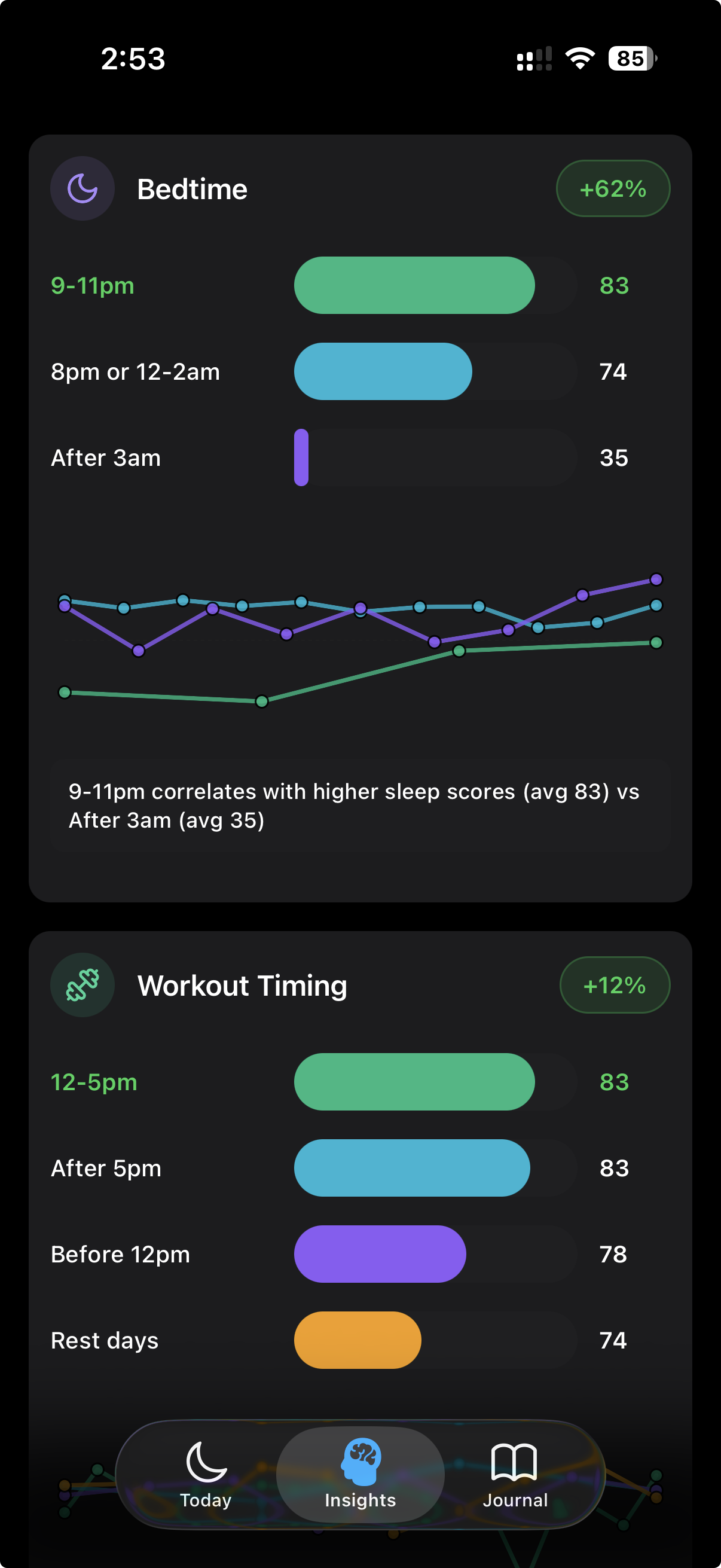
Reverie closes that gap. You can tag any night as a drinking night, and Reverie will correlate your tags with your measured sleep stages over time. Most users see an obvious pattern within two weeks.
What Reverie Tracks Around Alcohol
Reverie turns tags and sleep data into a clear picture of how drinking changes your specific night.
- • Average REM on drinking nights vs. sober nights
- • Deep sleep changes in the first half of the night
- • Overnight heart rate and HRV differences
- • 3 AM wake frequency on drinking nights
- • Dose response: 1 drink vs. 2 drinks vs. 3+ drinks
References
- Ebrahim IO, Shapiro CM, Williams AJ, Fenwick PB. “Alcohol and sleep I: effects on normal sleep.” Alcohol Clin Exp Res. 2013;37(4):539-549. Source
- Roehrs T, Roth T. “Sleep, sleepiness, and alcohol use.” Alcohol Res Health. 2001;25(2):101-109. Source
- Pietilä J, et al. “Acute Effect of Alcohol Intake on Cardiovascular Autonomic Regulation During the First Hours of Sleep in a Large Real-World Sample of Finnish Employees.” JMIR Ment Health. 2018. Source
- Prinz PN, et al. “Effect of alcohol on sleep and nighttime plasma growth hormone and cortisol concentrations.” J Clin Endocrinol Metab. 1980;51(4):759-764. Source
- Thakkar MM, Sharma R, Sahota P. “Alcohol disrupts sleep homeostasis.” Alcohol. 2015;49(4):299-310. Source
Related Articles
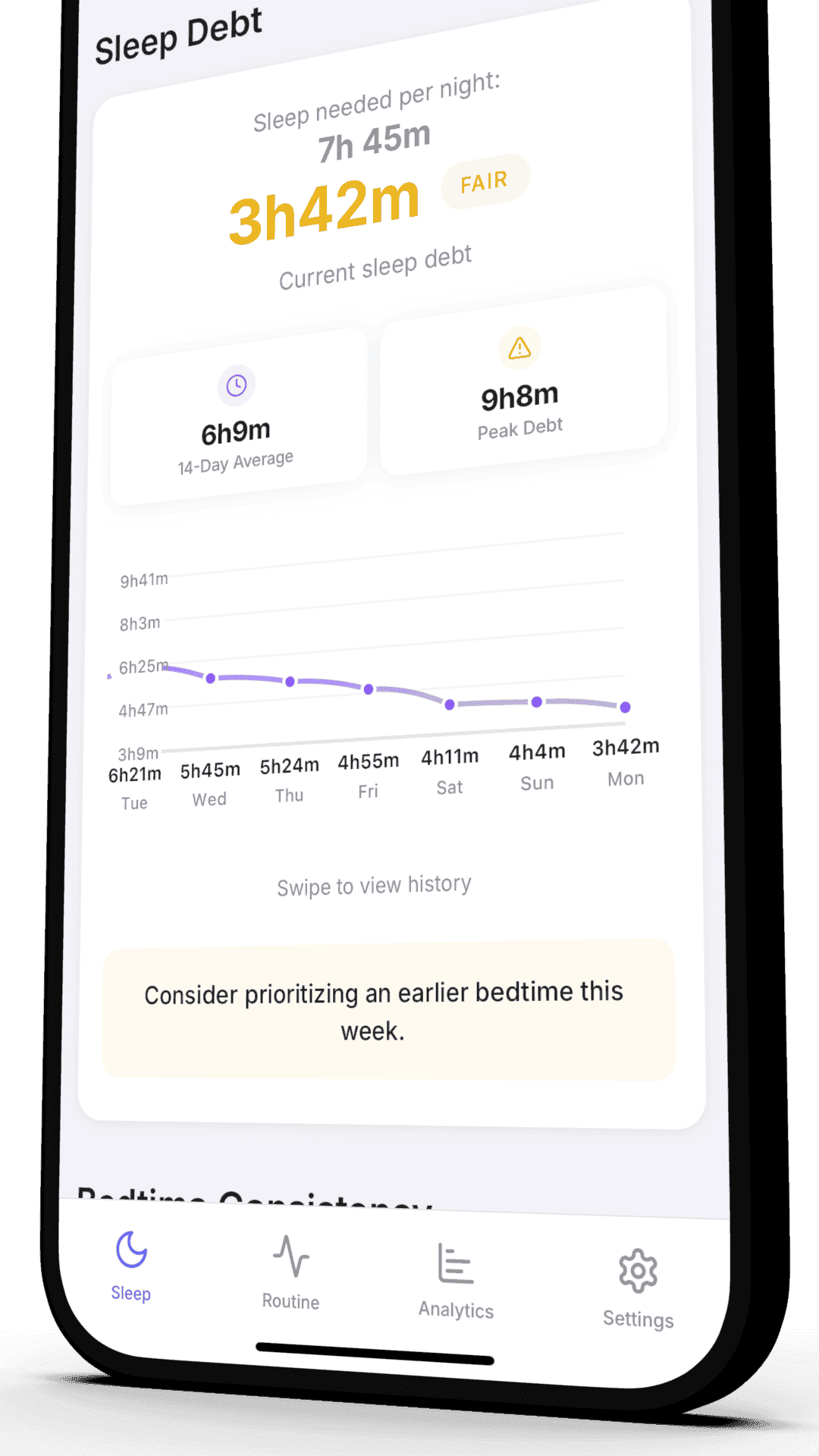
Caffeine and Sleep
The other evening habit that quietly erodes your sleep — and the half-life that explains it.
REM Sleep Explained
What REM does, how much you need, and why losing it is the core cost of a nightcap.
See What a Drink Really Does to Your Sleep
Join our beta and tag your drinking nights. Reverie correlates alcohol with your REM, deep sleep, and overnight heart rate so you can see the effect for yourself.
Free beta access. Shape the product. First to get updates. Requires Apple Watch.
Written by the Reverie Team
Based on sleep research and scientific studies