Caffeine and Sleep: The Science of Coffee's 6-Hour Half-Life
Most people believe their 4 PM coffee is long gone by the time they go to bed. It isn't. Caffeine's half-life is long enough that a measurable dose is still circulating when you try to fall asleep — and the data on how much sleep it steals is surprisingly precise.
Key Insight: A landmark 2013 study found that 400 mg of caffeine (roughly a strong cup of drip coffee) consumed 6 hours before bed reduced total sleep time by more than 1 hour. The same dose taken 3 hours before bed reduced sleep by over 40 minutes.
How Caffeine Actually Blocks Sleep
Throughout the day, your brain accumulates a molecule called adenosine. Adenosine binds to receptors that slow neural activity, and the more of it that builds up, the sleepier you feel. This is the chemistry behind what sleep scientists call sleep pressure — the urge to sleep that grows steadily from the moment you wake up.
Caffeine works by fitting into those same adenosine receptors and blocking them. It does not make you less tired — it makes your brain unable to hear the tired signal. The sleep pressure is still there, quietly accumulating. When caffeine clears, the full backlog hits at once, which is why some people feel suddenly exhausted a few hours after their last cup.
This mechanism has two consequences that matter for sleep. First, caffeine does not suppress your need for sleep — it masks it. Second, because your receptors are occupied, the brain adapts by producing more adenosine receptors over time, which is why habitual coffee drinkers feel unusually foggy on days they skip.
The Half-Life Math
Caffeine has an average half-life of 5 to 6 hours in healthy adults. That means 6 hours after drinking it, half the dose is still in your bloodstream. After 12 hours, a quarter is still there. The clearance curve is slow, and the amount still active at bedtime is larger than most people expect.
A 200 mg Coffee (One Large Cup)
The variability matters too. Half-life ranges from 3 hours in fast metabolizers to over 9 hours in slow metabolizers, driven largely by variants in the CYP1A2 liver enzyme. Pregnancy, some medications (including oral contraceptives), and liver disease can push half-life past 12 hours. Smokers, paradoxically, clear caffeine about 50 percent faster than non-smokers.
What the Research Actually Shows
The most-cited study on caffeine timing, published in the Journal of Clinical Sleep Medicine in 2013 by Drake and colleagues, gave participants 400 mg of caffeine at three timing points — immediately before bed, 3 hours before bed, and 6 hours before bed — and measured the effect on sleep both subjectively and with polysomnography.
6 Hours Before Bed
Total sleep time dropped by more than 60 minutes compared to the placebo night. The effect was statistically significant and — critically — participants did not report the difference subjectively. They did not feel that their sleep was worse. This is the point most people get wrong. You cannot tell from how you feel whether your afternoon coffee is stealing your sleep.
3 Hours Before Bed
Sleep loss of approximately 40 to 45 minutes. Increased wake after sleep onset. Reduced total sleep time and sleep efficiency.
At Bedtime
Roughly 60 minutes less sleep, plus significant disruption to sleep architecture, especially deep sleep in the first half of the night.
Beyond total sleep time, caffeine reduces slow-wave (deep) sleep and delays REM onset. Even when duration is preserved, the distribution of stages shifts toward lighter, less restorative sleep.
Why You May Be Underestimating Your Dose
Most dose advice assumes one cup of drip coffee, but the modern caffeine landscape is messier than that.
Espresso Drinks
A double shot is about 120-150 mg. A large latte often has 2-3 shots. An afternoon flat white can easily deliver 300 mg.
Cold Brew
Because of its concentration method, cold brew can hit 200-300 mg per 16 oz — roughly double a regular drip coffee of the same size.
Energy Drinks
80 to 300 mg per can, often alongside taurine and sugar that make the stimulant effect feel stronger without changing the sleep impact.
Pre-Workout Powders
Often contain 200-400 mg of caffeine plus additional stimulants. A 5 PM workout with pre-workout is almost guaranteed to disrupt that night's sleep.
Tea
Black tea has 40-70 mg per cup, green tea 25-45 mg. Matcha can reach 70 mg. Tea is lower dose but often consumed multiple times.
Dark Chocolate and Decaf
An ounce of dark chocolate has 15-25 mg. A cup of decaf still has 2-15 mg. Minor doses, but sensitive sleepers feel them.
How to Time Caffeine for Good Sleep
The practical question is not whether to drink coffee — for most people caffeine has real benefits — but how to place it in your day so it does not steal from your night.
Practical Rules
- Use an 8-10 hour cutoff.For a 10 PM bedtime, last caffeine by 12-2 PM. This leaves enough half-lives for most of the dose to clear.
- Delay your first cup.Waiting 60-90 minutes after waking lets cortisol peak naturally first, which makes the same dose feel stronger and lasts longer without a second cup.
- Know your metabolism.If you are a slow metabolizer — coffee jitters hours later, cannot tolerate afternoon caffeine — your cutoff should be earlier, not later.
- Watch hidden sources.Pre-workout, dark chocolate, some medications, and mate tea all count toward your daily load.
- Cap daily intake at 400 mg.The FDA considers 400 mg per day safe for most adults. More is not harmful for most people but makes sleep effects unavoidable.
- Test your baseline.Try a week without any caffeine after noon and watch your sleep tracker. The change in efficiency and deep sleep is usually visible.
How Reverie Helps You See the Effect
Caffeine's effect on sleep is often invisible in the moment — you fall asleep, you don't remember waking up, the morning feels fine. But the data tells a different story. Reduced deep sleep, more awakenings, lower efficiency. A sleep tracker that lets you log when you drink caffeine reveals the pattern within a week or two.
Log Habits, See Correlations
Reverie lets you tag nights with caffeine timing and dose. Over time you can see your personal cutoff — the point past which your sleep score starts to slide. For some people it is noon. For others it is 3 PM. The only way to know yours is to measure.
- • Log caffeine doses and timing with one tap
- • See correlations with deep sleep, REM, and efficiency
- • Discover your personal caffeine cutoff
- • Compare caffeine nights against your baseline
References
- Drake C, Roehrs T, Shambroom J, Roth T. "Caffeine effects on sleep taken 0, 3, or 6 hours before going to bed." J Clin Sleep Med. 2013;9(11):1195-1200. Source
- Clark I, Landolt HP. "Coffee, caffeine, and sleep: A systematic review of epidemiological studies and randomized controlled trials." Sleep Med Rev. 2017;31:70-78. Source
- Ribeiro JA, Sebastião AM. "Caffeine and adenosine." J Alzheimers Dis. 2010;20 Suppl 1:S3-15. Source
- Cornelis MC, El-Sohemy A. "Coffee, caffeine, and coronary heart disease." Curr Opin Clin Nutr Metab Care. 2007;10(6):745-751. Source
- Institute of Medicine. "Caffeine for the Sustainment of Mental Task Performance: Formulations for Military Operations." National Academies Press; 2001. Source
Related Articles
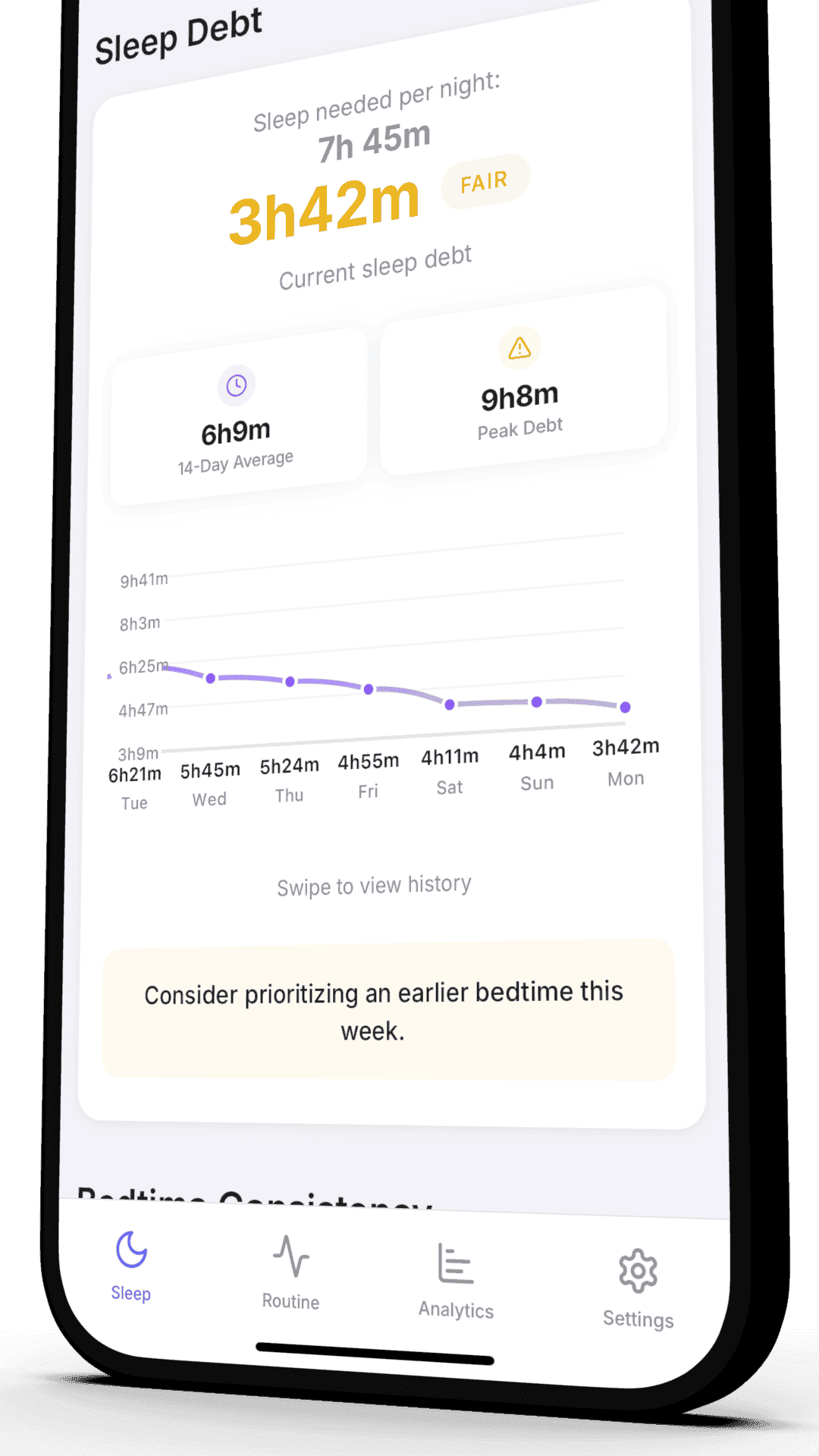
The Hidden Cost of Sleep Debt
How lost caffeine-stolen hours add up into measurable cognitive and physical costs.
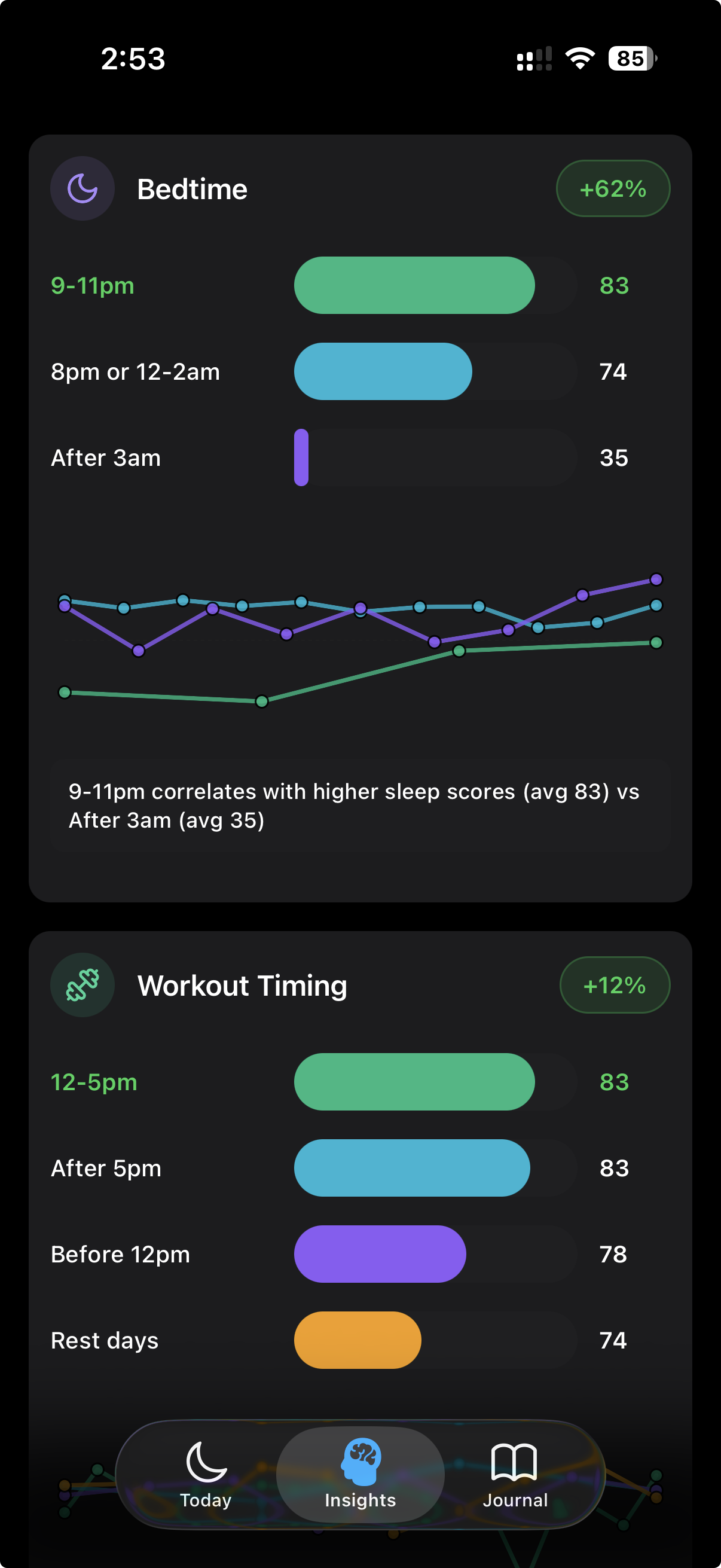
How Much Deep Sleep Do You Need?
Caffeine specifically suppresses deep sleep — the stage you can least afford to lose.
Find Your Caffeine Cutoff
Log your coffee, see your sleep. Reverie shows the correlation between your caffeine timing and your sleep quality, so you can set a cutoff that actually fits your biology.
Free beta access. Shape the product. First to get updates. Requires Apple Watch.
Written by the Reverie Team
Based on sleep research and scientific studies