REM Sleep Explained: What It Does and How to Get More
REM is the stage where you dream, where your brain files away memories, and where your emotional wiring gets calibrated for the next day. It is also the stage most people lose first when their sleep gets disrupted.
Key Insight: Adults typically spend 20% to 25% of their sleep in REM — about 90 to 120 minutes on an 8-hour night. The bulk of it happens in the final third of the night.
What Is REM Sleep?
REM stands for rapid eye movement, named after the darting eye motions researchers observed in sleeping subjects in the 1950s. During REM sleep, your brain activity looks almost identical to when you are awake. Your eyes move under closed lids, your breathing becomes irregular, and your heart rate rises.
At the same time, your body is essentially paralyzed. Your skeletal muscles go limp — a state called REM atonia — which stops you from acting out your dreams. This paralysis is controlled by neurons in the brainstem. When it malfunctions, people develop REM behavior disorder and physically act out their dreams.
Most vivid dreaming happens in REM. It is not the only stage where you dream — some fragmented imagery happens in non-REM stages too — but the long, emotional, narrative dreams you remember on waking almost all come from REM.
REM at a Glance
How Much REM Sleep Do You Need?
Healthy adults spend 20 to 25 percent of the night in REM. On an 8-hour night that equals roughly 90 to 120 minutes. Newborns spend closer to 50 percent of their sleep in REM, which is thought to support the explosive brain development of the first year of life. The proportion falls through childhood and stabilizes in early adulthood.
REM is not distributed evenly across the night. Your first REM period of the night is usually short — sometimes just 5 to 10 minutes — and arrives about 90 minutes after you fall asleep. Each subsequent cycle has a longer REM period, and the last cycle before you wake up can contain 30 to 60 minutes of REM in a single block.
This is why cutting your night short hurts REM disproportionately. Losing the last 90 minutes of an 8-hour night can remove 20 to 30 percent of your total REM sleep even though it only removes 19 percent of your total sleep time.
Why REM Sleep Matters
REM is not a passive state. Your brain is running specific processes during REM that it cannot do nearly as well while you are awake. The evidence from sleep research points to four distinct functions.
Emotional Processing
During REM your brain reactivates the memories of emotional experiences from the day, but with the stress chemistry turned down. Noradrenaline — the main stress neurotransmitter — drops to near zero during REM. Research from Matthew Walker's lab suggests this lets your brain process difficult experiences without the visceral fear response, which is why a bad day often feels more manageable after a good night of sleep.
Memory Integration
Deep sleep handles the raw consolidation of facts and events. REM does something different — it connects new memories to existing knowledge. Studies on creative problem-solving find that participants who had REM sleep between learning a task and retesting were significantly better at spotting hidden patterns and solving word-association puzzles.
Procedural Learning
Motor skills — playing an instrument, a sport, a new physical routine — show measurable improvement overnight after REM-rich sleep. If you practice a difficult piano passage in the evening and sleep a full 8 hours, you will typically perform it better the next morning than you did the night before. Cut the last two hours of sleep and that improvement largely disappears.
Brain Development
REM is where new neural connections get reinforced. This is why infants spend so much of their sleep in REM and why REM is thought to play a role in maintaining brain plasticity into adulthood. Chronically low REM is associated with reduced cognitive flexibility and slower learning.
What Reduces REM Sleep
Because REM is concentrated in the second half of the night and is very sensitive to body temperature and neurotransmitter levels, several common habits suppress it directly.
Alcohol
Alcohol is the single biggest suppressor of REM. Even two drinks in the evening can cut your REM time by 20 to 30 percent. The first half of the night looks normal, but your brain cannot enter REM properly while metabolizing alcohol, so you lose the long REM blocks at the end of the night.
Cutting Sleep Short
Because REM bunches into the last third of the night, losing even one hour of sleep can remove a disproportionate share of your total REM. Waking up at 5 AM when you needed to sleep until 7 AM means skipping your longest REM cycle.
SSRIs and Other Medications
Several antidepressants — particularly SSRIs and tricyclics — significantly suppress REM as a side effect. This is not always a reason to stop taking them, but it is worth discussing with a doctor if you are noticing memory or mood issues.
High Room Temperature
REM sleep impairs your body's ability to regulate its own temperature. In a warm room, your body struggles to stay cool during REM and will often cut the REM episode short as a protective response. A cool bedroom directly supports longer REM periods.
Late Caffeine
Caffeine in your system at bedtime reduces both total sleep time and REM percentage. The effect is strongest when caffeine is consumed within 6 hours of bed.
Cannabis
THC is a strong REM suppressor. Regular cannabis users often have 40 to 50 percent less REM than non-users. When they stop, REM rebounds sharply — which is why quitting often leads to intense, vivid dreams for a week or two.
How to Get More REM Sleep
You cannot directly choose to have more REM, the way you might force yourself to eat more protein. But you can set up the conditions that let REM happen naturally. The research points to a short list of things that work.
Evidence-Based REM Sleep Habits
- Protect the last hour of sleep.This is the single highest-leverage change. Because REM is back-loaded, every hour you sleep after the 6-hour mark is REM-rich. A 7-hour night gives you far more REM than a 6-hour night — not just 17 percent more.
- Keep a regular wake time.Your final REM cycle is coordinated by your circadian rhythm, not just your sleep pressure. A consistent wake time anchors that rhythm so your body knows when to deliver the long REM block.
- Avoid alcohol in the evening.If you want to drink, finish at least 3 hours before bed. Your liver needs that time to metabolize ethanol before you hit the REM-heavy part of the night.
- Keep your bedroom cool.65 to 68°F (18 to 20°C) is the sweet spot. Warmer rooms shorten REM episodes.
- Use light strategically.Getting bright light within an hour of waking — ideally outdoors — anchors your circadian rhythm and improves REM the following night.
How Apple Watch Tracks REM Sleep
Apple Watch Series 4 and later, with watchOS 9 or newer, can detect REM sleep using a combination of accelerometer, heart rate, and heart rate variability data. REM has a distinctive signature: heart rate becomes more variable, breathing becomes irregular, and body movement is almost completely absent except for brief micro-twitches. Apple's sleep-staging model picks this up reasonably well when the watch is worn snugly.
The Apple Health app will show you your REM sleep minutes each night, but it does not tell you what is affecting those numbers. If your REM drops from 90 minutes to 60 minutes, Apple Health will not tell you that the glass of wine you had at dinner is the likely reason.
How Reverie Helps You Understand REM
Reverie reads the REM data your Apple Watch collects and overlays it with your daily habits. You can see exactly which lifestyle choices are moving your REM up or down, night by night.
- • Track your REM percentage and trend over time
- • See how alcohol and late caffeine affect your REM
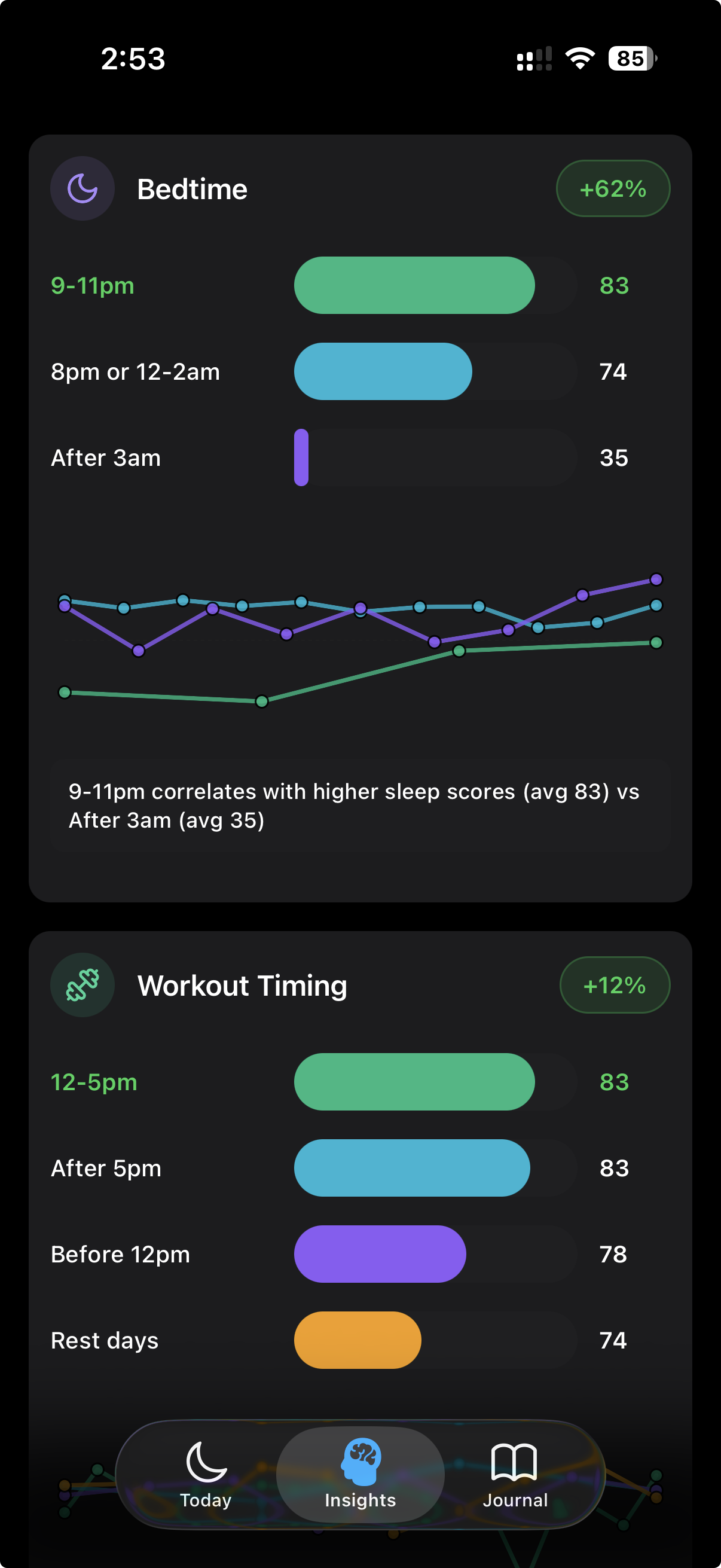
- • Spot which bedtime gives you the most REM
- • Get a sleep score that weights REM appropriately
References
- Siegel JM. "REM sleep: a biological and psychological paradox." Sleep Medicine Reviews. 2011;15(3):139-142. Source
- Walker MP, van der Helm E. "Overnight therapy? The role of sleep in emotional brain processing." Psychological Bulletin. 2009;135(5):731-748. Source
- Cai DJ, et al. "REM, not incubation, improves creativity by priming associative networks." PNAS. 2009;106(25):10130-10134. Source
- Ebrahim IO, et al. "Alcohol and sleep I: effects on normal sleep." Alcohol Clin Exp Res. 2013;37(4):539-549. Source
- Wilson S, Argyropoulos S. "Antidepressants and sleep: a qualitative review of the literature." Drugs. 2005;65(7):927-947. Source
- Parmeggiani PL. "Thermoregulation and sleep." Front Biosci. 2003;8:s557-s567. Source
Related Articles
How Much Deep Sleep Do You Need?
REM's counterpart. Learn how much slow-wave sleep you need and why.
The 90-Minute Sleep Cycle
How REM fits into the larger architecture of a full night's sleep.
Ready to Optimize Your Sleep?
Join our beta program and discover what is affecting your REM sleep. Get personalized insights and build better sleep habits with Reverie.
Free beta access. Shape the product. First to get updates. Requires Apple Watch.
Join 50 beta testers already improving their sleep
Written by the Reverie Team
Based on sleep research and scientific studies