Blue Light and Sleep: What the Research Actually Shows
Blue light is the most over-simplified topic in sleep advice. It is blamed for every sleep problem and sold as the reason you need $80 amber glasses. The real science is more interesting, more nuanced, and more useful — because it points to a different fix than most headlines suggest.
Key Insight: The intrinsically photosensitive retinal ganglion cells (ipRGCs) that detect blue light are real, but the effect of phone screens on sleep is smaller than commonly claimed — brightness and total light exposure matter more than color.
What Blue Light Actually Is
Blue light is a portion of the visible spectrum, roughly between 400 and 500 nanometers. The wavelength range that matters most for your circadian system is narrower than that — about 460 to 480 nanometers. At these wavelengths, sunlight is rich, fluorescent office lights are strong, and LED screens are moderate.
Your retina contains more than just rods and cones. A third class of photoreceptor, called intrinsically photosensitive retinal ganglion cells, or ipRGCs, was identified in the early 2000s. These cells do not help you see images. Their only job is to measure ambient light, especially in the blue range, and send that signal to the suprachiasmatic nucleus — the brain's master clock.
When ipRGCs detect blue-rich light, the clock concludes it is daytime and suppresses melatonin. When ipRGCs detect dim or warm light, the clock concludes it is night and begins the melatonin rise that prepares you for sleep. This signaling system is ancient, powerful, and mostly designed for sunlight — not phones.
Key Terms
How It Suppresses Melatonin
Under laboratory conditions, blue light is a potent melatonin suppressor. Gooley and colleagues, working at Brigham and Women's Hospital, exposed volunteers to several hours of typical room light (around 200 lux) before bedtime and measured a melatonin suppression of roughly 50% compared to dim light. When exposure extended past the usual sleep onset time, the duration of the melatonin peak shortened by about 90 minutes.
The size of the effect depends heavily on intensity. Direct sunlight delivers roughly 10,000 to 100,000 lux. A bright office delivers 500 to 1,000 lux. A typical living room with ceiling lights delivers 100 to 300 lux. A phone held close to the face delivers about 30 to 40 lux of light to the eye. An eReader held similarly can deliver 30 to 100 lux.
In another well-cited study, Chang and colleagues showed that reading on a light-emitting eReader for four hours before bed, compared to reading a paper book, delayed melatonin onset by 90 minutes and reduced next-morning alertness. That study is often cited as proof that phones wreck sleep — but the exposure duration was four hours, uninterrupted, at close range. A 20-minute scroll is a very different dose.
Why Phone Screens Are Weaker Than You Think
A surprising amount of the "phones ruin sleep" narrative comes from extrapolating laboratory intensities to real-world exposure. In the lab, to get a clean melatonin signal, researchers often use 500 to 1,000 lux of blue-enriched light for several hours. Your phone does not come close to that.
A 2019 systematic review led by Tähkämö pulled together dozens of light-and-circadian studies and found that intensity and total duration of light exposure are far stronger predictors of melatonin suppression than wavelength alone. A dimly lit living room with warm bulbs can actually produce more circadian disruption than a phone used briefly, because you stay in it for hours.
Researchers from Harvard and Monash have repeatedly pointed out that the ceiling lights, lamps, televisions, and ambient room light that you ignore are probably doing more to your clock than the phone you worry about. The phone is close to your eye, which matters, but its total light output is small compared to the room around it.
Close But Small
A phone held 30cm from your face delivers much less light to the eye than a ceiling fixture 2 meters away — even though the phone feels brighter because it fills your central vision.
Total Dose Matters
A 15-minute bedtime scroll is roughly 10 lux-hours of exposure. The living room you sat in for three hours before that is 600+ lux-hours. The bedside lamp you keep on while you "wind down" may be more disruptive than the phone you blame.
Content Arousal Is Separate
Most of the sleep damage from phones is behavioral, not photic. Arguments on social media, anxious work email, and doomscrolling spike cortisol and delay sleep onset independently of any light effect. A calm book on a bright phone may be less disruptive than a tense conversation in a dim room.
Heo 2017: Blue Filter, No Difference
A 2017 randomized crossover trial by Heo and colleagues had healthy adults use smartphones at night with and without the blue-light filter enabled. Sleep onset, sleep efficiency, and next-morning alertness did not meaningfully differ between conditions — in real-world smartphone use, toggling the blue filter changed almost nothing.
Do Blue Light Glasses Work?
The amber-lens blue-light-blocking glasses industry has built itself on a plausible mechanism and weak evidence. The mechanism is real — amber lenses do filter part of the 460 to 480nm range. The clinical evidence that this translates into better sleep for a typical person is largely absent.
A 2017 systematic review by Lawrenson and colleagues, published in Ophthalmic Physiological Optics, pooled the controlled trials on blue-light-blocking lenses and concluded that the evidence for benefit on sleep, eye strain, and visual performance was low quality and largely null. Several later individual trials have shown small benefits in narrow populations — for example, shift workers doing extensive evening screen work — but nothing approaching the claims on the packaging.
Probably Do Not Help
Normal adults using phones briefly in the evening. Students reading on laptops for an hour before bed. Anyone whose sleep problem is not light-driven.
Might Help
Night-shift workers who cannot avoid bright screens for hours. People with delayed sleep phase disorder. Anyone exposed to intense blue-rich light late in the circadian day.
What Actually Helps for Night Screen Use
Once you accept that brightness matters more than colour, the practical advice changes. You do not need special glasses — you need less total light in the last hour before bed.
Actually-Useful Strategies
- Dim your device.Lowering screen brightness cuts lux-to-eye far more than enabling a blue filter. Use the lowest brightness you can still read comfortably.
- Dim the room.Ceiling lights and bright lamps are the bigger story. Switch to one warm lamp in the last hour before bed. Your circadian system notices.
- Use Night Shift or f.lux.The effect size is small, but it is free and it is paired with a useful behaviour — it reminds you that bedtime is approaching.
- Cut the content, not just the colour.A calm book at 100% brightness will beat stressful email on the dimmest possible screen. Choose what you put into your brain, not just the spectrum.
- Get bright light in the morning.Morning sunlight is the single most effective circadian intervention you can make — more important than any evening-light reduction.
How Apple Watch Tracks Your Light Exposure
Every Apple Watch has an ambient light sensor on its face. Starting in recent watchOS versions, that sensor feeds an "Ambient Light" and "Time in Daylight" metric into the iOS Health app, alongside an estimate of how much bright outdoor light you got each day.
This is a better data stream than most people realise. You can glance at a week and see whether your morning-light exposure has been adequate, and whether your evenings are as dim as you assume they are. The numbers often surprise people — the "dark" room is brighter than it feels.
How Reverie Uses Light Exposure
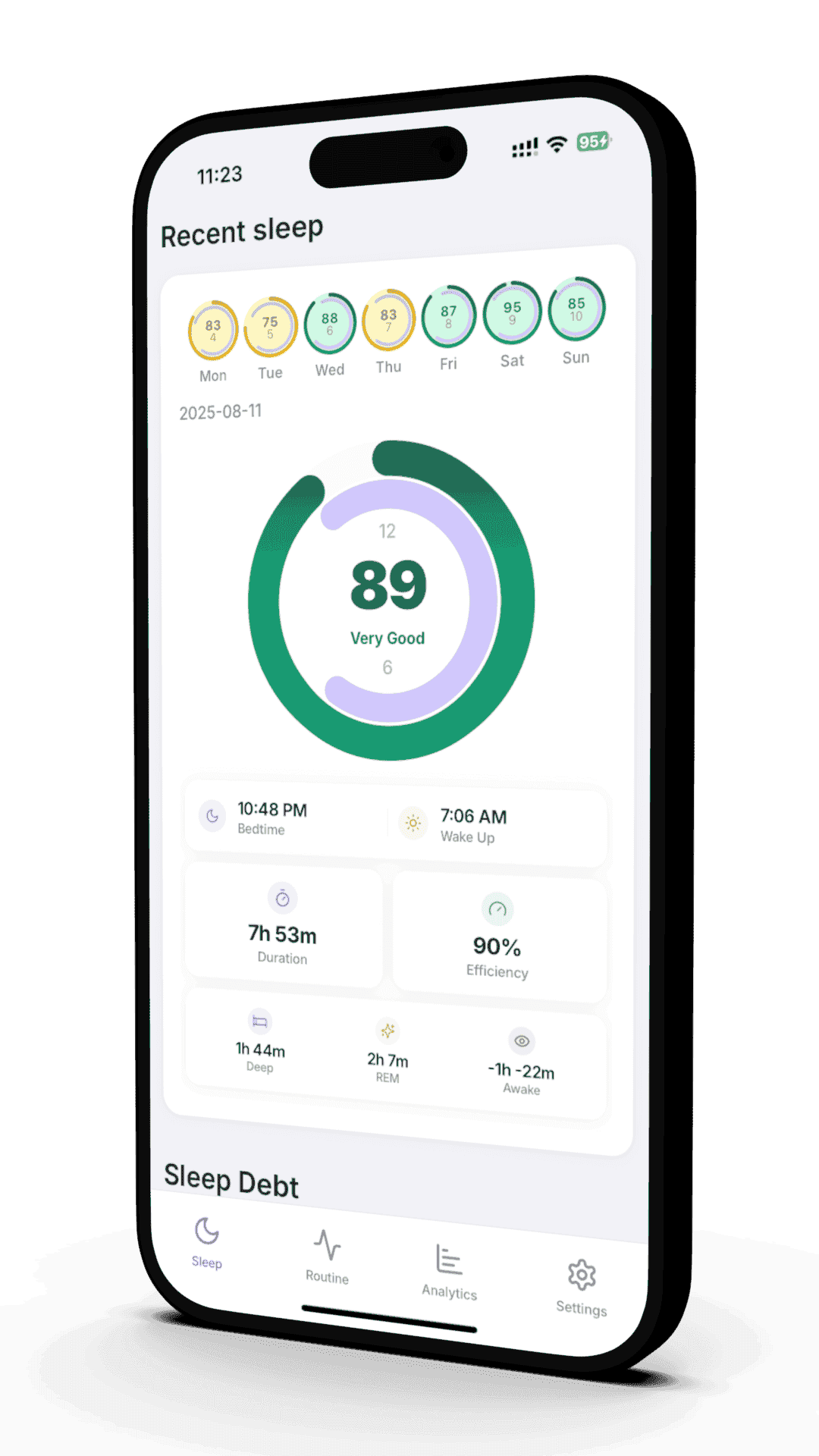
Reverie combines Apple Watch light exposure data with your sleep score and habit log, so you can see which light patterns are actually linked to your best nights — and whether the evening screen time you worry about is even a factor.
- • Daily daylight-exposure summary
- • Sleep score trend alongside light patterns
- • Surface the habits correlated with your best sleep
- • Evening screen time tracking without guilt-based nudges
References
- Chang AM, Aeschbach D, Duffy JF, Czeisler CA. "Evening use of light-emitting eReaders negatively affects sleep, circadian timing, and next-morning alertness." Proc Natl Acad Sci USA. 2015;112(4):1232-1237. Source
- Gooley JJ, et al. "Exposure to room light before bedtime suppresses melatonin onset and shortens melatonin duration in humans." J Clin Endocrinol Metab. 2011;96(3):E463-472. Source
- Lawrenson JG, Hull CC, Downie LE. "The effect of blue-light blocking spectacle lenses on visual performance, macular health and the sleep-wake cycle: a systematic review." Ophthalmic Physiol Opt. 2017;37(6):644-654. Source
- Tähkämö L, Partonen T, Pesonen AK. "Systematic review of light exposure impact on human circadian rhythm." Chronobiol Int. 2019;36(2):151-170. Source
- Heo JY, et al. "Effects of smartphone use with and without blue light at night in healthy adults: A randomized, double-blind, cross-over, placebo-controlled comparison." J Psychiatr Res. 2017;87:61-70. Source
Related Articles
Screen Time Before Bed
The behavioural side of phones at bedtime, separate from any light effect.
The Power of Sleep Consistency
Why your circadian rhythm cares more about regularity than any single night.
See What Actually Moves Your Sleep
Join our beta program and find out whether evening screens are really the issue — or whether something else is holding back your nights. Reverie reads your Apple Watch data and shows you the pattern.
Free beta access. Shape the product. First to get updates. Requires Apple Watch.
Written by the Reverie Team
Based on sleep research and scientific studies