Sleep Efficiency: The Metric That Matters More Than Duration
Two people can both spend 8 hours in bed and get very different amounts of sleep. Sleep efficiency is the number that captures that gap — and sleep researchers use it as one of the most reliable signals of how rested you actually are.
Key Insight: Healthy adults have a sleep efficiency of 85 percent or higher. Falling below that threshold consistently is one of the earliest warning signs of insomnia, sleep apnea, or circadian misalignment.
What Is Sleep Efficiency?
Sleep efficiency is the ratio of time spent asleep to time spent in bed, expressed as a percentage. If you were in bed for 8 hours and slept for 7, your sleep efficiency is 87.5 percent. If you were in bed for 9 hours but only slept 7, your efficiency drops to 77.8 percent — even though you slept the same amount.
Time in bed starts when you lie down to sleep and ends when you get up for the day. Total sleep time excludes the minutes spent awake — falling asleep, lying awake in the middle of the night, or waiting for your alarm.
The metric was formalized in clinical sleep medicine in the 1980s as a way to distinguish insomnia from other sleep problems. Someone spending 10 hours in bed and sleeping 6 does not have a duration problem — they have an efficiency problem. And the fix is very different from just telling them to go to bed earlier.
Why Efficiency Beats Duration
Sleep duration is the number everyone tracks, but it has a fundamental blind spot: it does not distinguish between restorative sleep and fragmented, shallow sleep. Two 7-hour nights can differ enormously in how rested they leave you. Efficiency captures that difference.
It Measures What Works
A high efficiency means your brain entered and stayed in sleep quickly. A low efficiency means you spent too much of your bedtime awake — either falling asleep slowly, waking up during the night, or both. Only one of those is actually doing the work of sleep.
It Detects Fragmentation
Someone with sleep apnea may spend 8 hours in bed but wake up briefly 30 times an hour. Duration looks fine. Efficiency plummets. This is why sleep clinicians prefer efficiency — it catches problems that total hours conceal.
It Is a Stable Personal Baseline
Your ideal duration can shift with age, training load, and season. Your efficiency should stay relatively stable. A sudden drop from your usual 90 percent to 78 percent is a meaningful signal even if your total sleep time looks similar.
What Counts as a Good Sleep Efficiency?
Clinical sleep guidelines for adults converge on 85 percent as the floor for good sleep. Above 90 percent is strong. Below 80 percent is typically considered a marker for evaluation.
Efficiency drops naturally with age. A healthy 25-year-old often runs 93 to 95 percent. A healthy 65-year-old may sit at 82 to 86 percent. This is normal — older adults have lighter, more fragmented sleep and that is built into their biology. What matters is whether you are stable near your age-appropriate baseline.
One caveat: efficiency can be artificially inflated. If you only get into bed when you are already exhausted, you will fall asleep in 2 minutes and never wake — which looks like 98 percent efficiency but actually reflects chronic sleep deprivation. A healthy night includes a few brief awakenings you do not remember. Perfection is suspicious.
What Lowers Sleep Efficiency
Low efficiency is almost always a mismatch: something about your time in bed, your environment, or your physiology is preventing sleep from happening when your body is lying there waiting for it.
Going to Bed Too Early
If your body is not yet ready for sleep and you lie in bed anyway, you create 30 or 60 minutes of wakefulness that lowers efficiency. This is the single most common cause of a drop from 90 to 80 percent in otherwise healthy people.
Sleep Apnea
Breathing pauses cause dozens of micro-arousals per hour. Most people do not remember them, but they show up as fragmentation that cuts efficiency from 90 to 70 percent.
Late Caffeine
Caffeine has a half-life of 5 to 6 hours. A 3 PM coffee can still be half-active at 9 PM, delaying sleep onset and producing shallow early-night sleep. Efficiency drops even if you eventually sleep a full 8 hours.
Anxiety and Racing Thoughts
Psychophysiological insomnia — the formal term for anxiety-driven sleep trouble — mostly shows up as low efficiency. Duration can look normal, but the time in bed is filled with wakefulness.
Alcohol
Alcohol makes falling asleep easier but dramatically fragments the second half of the night. Total sleep time may look fine, but efficiency drops by 5 to 10 points.
Jet Lag and Shift Work
When your circadian rhythm is pointing one way and you are lying down at a time that opposes it, the result is long wakeful stretches and an efficiency that can dip below 70 percent until you adjust.
How to Improve Your Sleep Efficiency
The counterintuitive fix for most low efficiency is to spend less time in bed, not more. Clinical sleep therapy has a name for this: sleep restriction. The idea is to match your time in bed to your actual sleep need until efficiency climbs back above 90 percent, then gradually extend the window.
Strategies That Work
- Only get into bed when sleepy.If you are not sleepy, read on the couch or stretch in another room. Do not train your brain to associate the bed with wakefulness.
- Leave the bed if you cannot sleep.If you are awake for more than 20 minutes, get up and do something quiet and boring in dim light until you feel sleepy again.
- Keep a consistent wake time.Anchor one end of the window. A stable wake time builds predictable sleep pressure and locks your circadian rhythm to the schedule you want.
- Cut caffeine after noon.Most late-efficiency problems trace back to afternoon caffeine that is still active at bedtime.
- Rule out sleep apnea.If you snore, wake up gasping, or have persistent efficiency below 80 percent despite good habits, get a home sleep test.
How Apple Watch Calculates Sleep Efficiency
Apple Watch estimates time in bed from your sleep schedule and your motion and heart rate data. It estimates sleep time by detecting the motion and cardiovascular patterns typical of each sleep stage. Dividing the second by the first gives your efficiency for the night.
Apple Health reports your total sleep time and a basic stage breakdown, but it does not surface sleep efficiency as a number or explain what it means. For a metric this important, that is a significant gap.
How Reverie Uses Sleep Efficiency
Reverie shows your sleep efficiency as a daily number, tracks it over time, and flags when it drops below your baseline — often catching problems weeks before you notice them subjectively.
- • Daily efficiency with a 14-day trend
- • Personal baseline based on your last 30 nights
- • Alerts when efficiency drops meaningfully
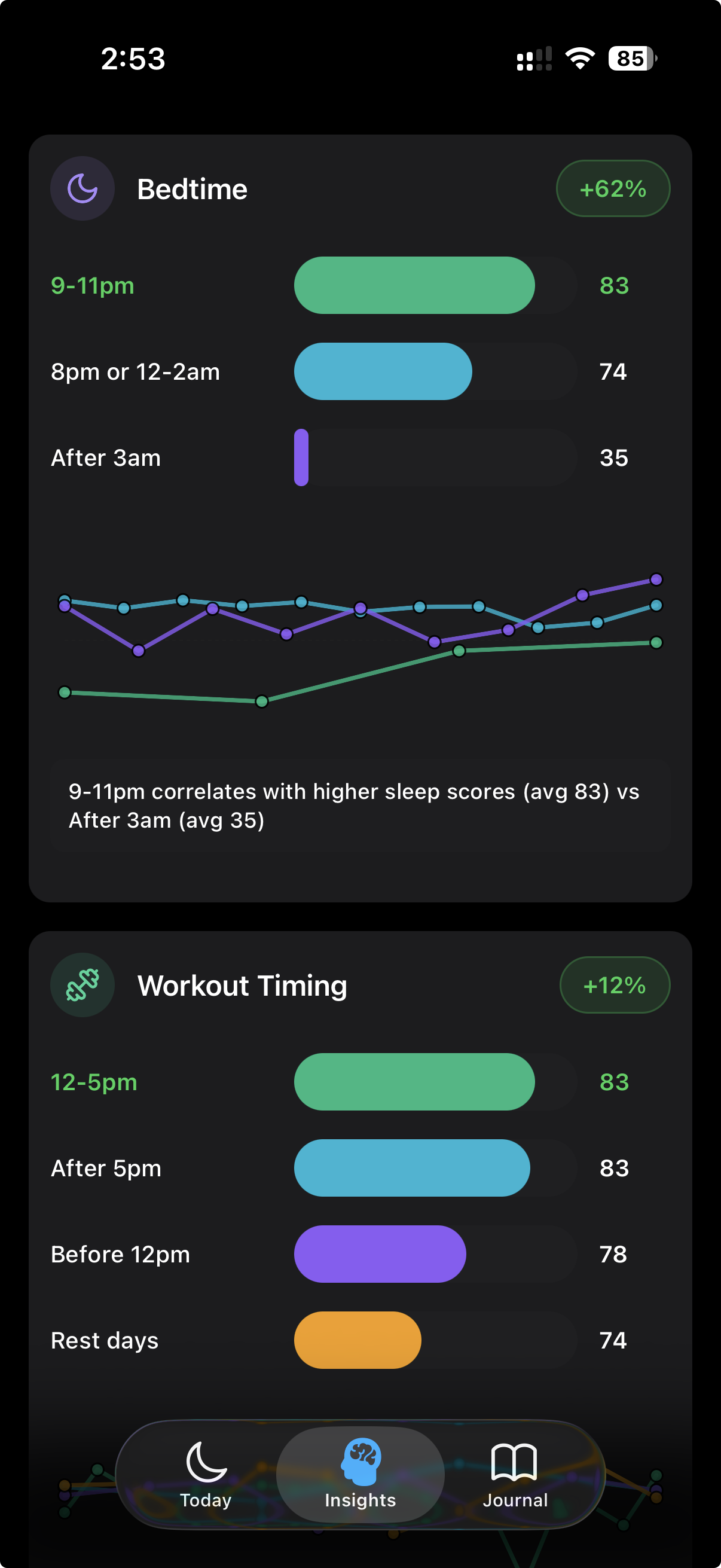
- • Correlations with habits that affect it (caffeine, exercise, bedtime)
References
- Buysse DJ. "Sleep health: can we define it? Does it matter?" Sleep. 2014;37(1):9-17. Source
- Reed DL, Sacco WP. "Measuring Sleep Efficiency: What Should the Denominator Be?" J Clin Sleep Med. 2016;12(2):263-266. Source
- Ohayon MM, Carskadon MA, Guilleminault C, Vitiello MV. "Meta-analysis of quantitative sleep parameters from childhood to old age in healthy individuals." Sleep. 2004;27(7):1255-1273. Source
- Spielman AJ, Saskin P, Thorpy MJ. "Treatment of chronic insomnia by restriction of time in bed." Sleep. 1987;10(1):45-56. Source
- Morin CM, et al. "Cognitive behavioral therapy, singly and combined with medication, for persistent insomnia: a randomized controlled trial." JAMA. 2009;301(19):2005-2015. Source
Related Articles
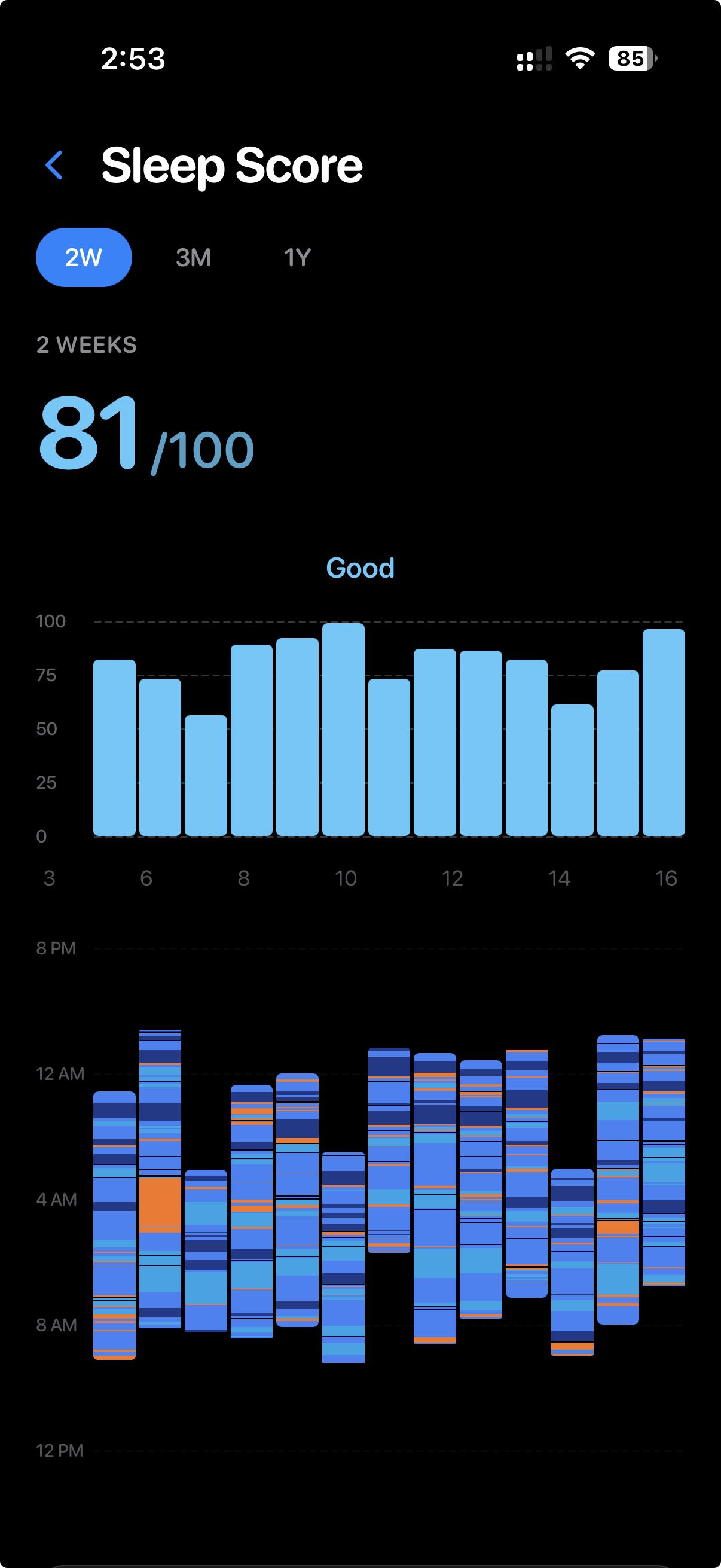
The Power of Sleep Consistency
The partner metric to efficiency — stable bedtimes drive stable efficiency.
How Much Deep Sleep Do You Need?
Efficiency is the container. Deep sleep is the content that makes it count.
Know Your Sleep Efficiency
Join our beta and see your sleep efficiency tracked night by night. Reverie surfaces the metric Apple Health keeps hidden, with context for what drives it up or down.
Free beta access. Shape the product. First to get updates. Requires Apple Watch.
Written by the Reverie Team
Based on sleep research and scientific studies