Exercise and Sleep: When to Work Out for Better Recovery
Exercise is the cheapest, most effective sleep aid available. It increases deep sleep, shortens the time it takes to fall asleep, and improves total sleep quality — but only if you time it right. Workout timing is one of the few levers where a small change can flip a night from restorative to fragmented.
Key Insight: A 2017 meta-analysis of 66 studies found that regular exercise improves total sleep time by 13 to 18 minutes and sleep efficiency by 2 to 8 percent. The effect shows up within 2 to 4 weeks and grows with consistency.
Why Exercise Improves Sleep
Exercise acts on sleep through several mechanisms at once, which is why its effect is larger than almost any other lifestyle intervention. Each mechanism targets a different part of the sleep system.
Increased Sleep Pressure
Physical activity increases adenosine accumulation — the molecule that builds up through the day and creates the urge to sleep. A long run or a hard lifting session can raise sleep pressure enough that your first cycle starts faster and your first deep-sleep block is deeper.
Core Temperature Drop
Exercise raises core body temperature. In the hours after a workout, temperature drops below its pre-workout baseline. That drop is one of the physical signals your brain uses to initiate sleep, which is why the timing of the temperature curve matters for when you fall asleep.
Circadian Reinforcement
Morning exercise, especially outdoors, delivers a strong phase-setting signal to your circadian clock. It pulls your cortisol peak earlier and your melatonin onset earlier, anchoring your sleep-wake rhythm to your intended schedule.
Mood and Stress Regulation
Exercise reduces cortisol and increases endorphins and BDNF. For people whose sleep problems are driven by anxiety or rumination, this is often the single most impactful change.
How Timing Changes the Effect
The conventional advice — "do not exercise in the evening" — is now considered out of date. The current evidence is more nuanced: timing matters, but the dominant factor is the length of the gap between the workout and your bedtime, not the time of day in absolute terms.
Rough Guide: Hours Before Bed and Sleep Impact
A 2019 systematic review in Sports Medicine concluded that evening exercise ending at least 1 hour before bed does not disrupt sleep in most people. The exception is vigorous exercise — especially HIIT, heavy intervals, or competitive training — in the 60 to 90 minutes before bed, which consistently shows measurable disruption.
Intensity and Type Matter
Not all exercise has the same effect on sleep. A 40-minute easy jog has a different downstream signature than a 40-minute hard interval session, even though the clock time is identical.
Moderate Cardio
Easy runs, walking, steady-state cycling. The most reliably sleep-positive type. Increases deep sleep, minimal risk of disruption even in the evening. Great for anyone with insomnia or anxiety-driven sleep issues.
High-Intensity Intervals
Maximum deep-sleep gain when done in the morning or midday. Evening HIIT is where most problems show up — sympathetic nervous system activation can take 2 to 3 hours to fully subside.
Strength Training
Increases deep sleep and growth hormone release. Less circadian impact than cardio. Generally safe to do in the evening, but heavy compound lifts still benefit from a 2-hour wind-down before bed.
Yoga and Stretching
One of the few forms of movement that can be done right before bed without disrupting sleep. Parasympathetic activation and slow breathing make it actively sleep-promoting.
Long Endurance Sessions
A very long run or ride can raise heart rate variability and core temperature for hours afterward. Endurance athletes often see their worst sleep on the night of their longest session.
Competitive Sport
The combination of physical intensity and psychological arousal from competition creates the largest sleep-disruption effect. Athletes often need 3 or more hours of wind-down after a match.
Common Mistakes
Most exercise-related sleep problems come from a few repeated patterns rather than from exercise itself.
Pre-Workout With Late Training
A 6 PM workout with 300 mg of caffeine in pre-workout is effectively caffeine at 6 PM, and that caffeine will still be active at bedtime. The sleep disruption is often blamed on exercise when it is really the stimulant.
Skipping the Cool Down
Going directly from a hard session to screen time keeps cortisol and heart rate elevated. 10 minutes of walking or stretching after the workout speeds the return to parasympathetic dominance.
Overtraining
Exercise improves sleep up to a point. Past that point — especially for endurance athletes in heavy training blocks — sleep quality deteriorates. Reduced deep sleep is one of the earliest signs of overtraining syndrome.
Hot Showers Right After a Workout
A hot shower can delay the core temperature drop your body needs to initiate sleep. A lukewarm shower, or waiting 60-90 minutes before a hot one, avoids the issue.
Practical Guidance
The best workout for your sleep is the workout you will actually do consistently. Consistency beats perfect timing. Within that, here is how to place your sessions.
Guidelines That Work
- Aim for 150 minutes per week.The WHO guideline for adults is 150 minutes of moderate activity per week. That is enough to produce a measurable sleep benefit in most people.
- Morning cardio if you can.A 20-30 minute walk, jog, or bike ride in morning sunlight gives you the circadian signal, the mood boost, and the deep-sleep benefit in one session.
- Leave 2 hours between hard training and bed.For HIIT, heavy lifting, or intervals, end at least 2 hours before bedtime. A 9 PM wind-down means the last hard set by 7 PM.
- Evening sessions should be lower intensity.If your only workout time is evening, favor steady cardio, light strength work, or yoga over max effort.
- Never do pre-workout after 2 PM.Pre-workout is caffeine with extra steps. Apply the same cutoff you would apply to coffee.
- Track your own response.Individual response varies more than the research averages suggest. Some people sleep best after 9 PM runs. Others cannot handle a 6 PM walk. A sleep tracker reveals your personal pattern.
How Reverie Connects Training to Sleep
Apple Watch already tracks your workouts and your sleep, but Apple Health does not connect the two. You can see a run and you can see last night's sleep, but nothing tells you whether that 5 PM HIIT session is why your deep sleep dropped.
See the Link Between Your Workouts and Your Sleep
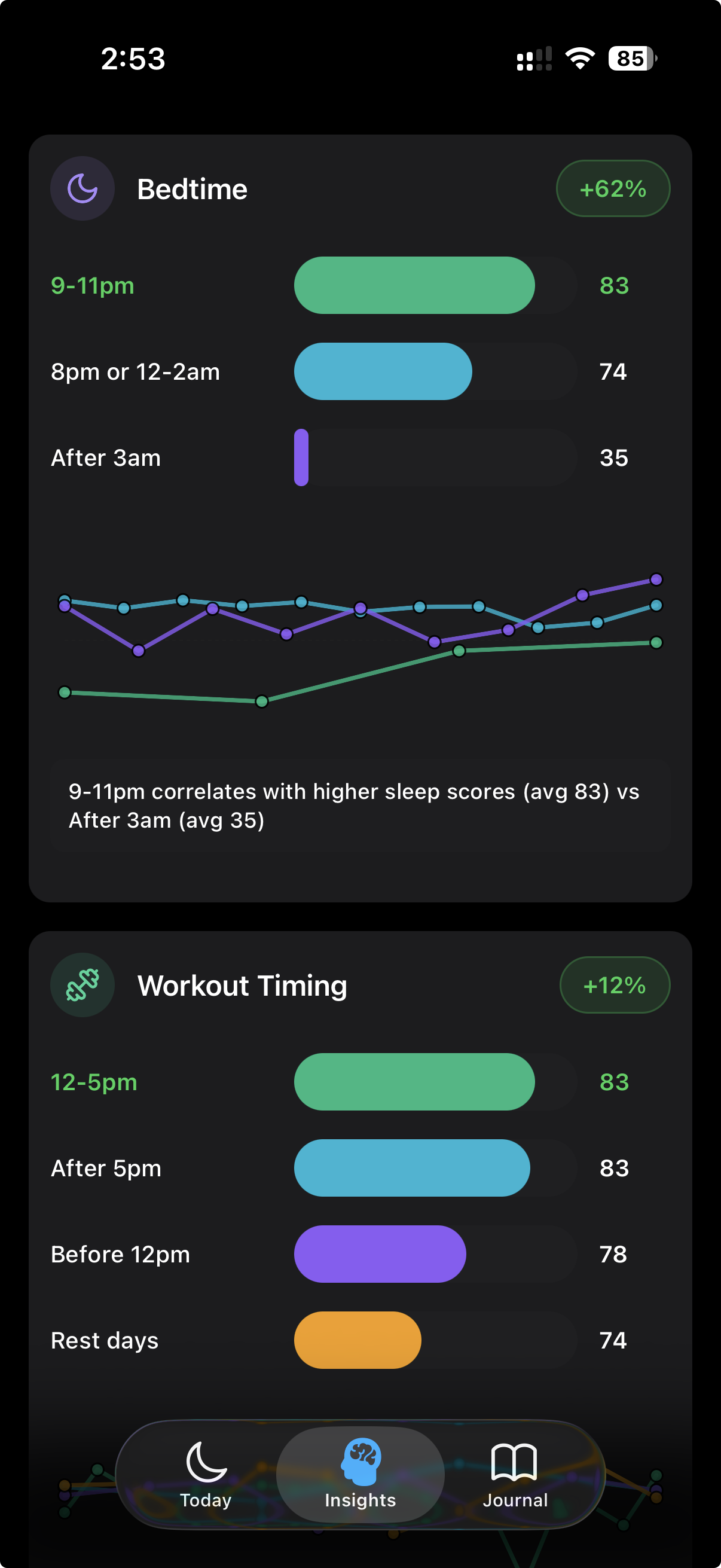
Reverie pulls your workout timing and intensity from Apple Health and correlates it with your sleep metrics. You can see which types of sessions, at which times of day, produce your best nights.
- • Workout-to-sleep correlations across 30 days of data
- • Identify your best and worst training times for sleep
- • Track deep sleep response to intensity and duration
- • Flag overtraining patterns through sleep degradation
References
- Kredlow MA, Capozzoli MC, Hearon BA, Calkins AW, Otto MW. "The effects of physical activity on sleep: a meta-analytic review." J Behav Med. 2015;38(3):427-449. Source
- Stutz J, Eiholzer R, Spengler CM. "Effects of Evening Exercise on Sleep in Healthy Participants: A Systematic Review and Meta-Analysis." Sports Med. 2019;49(2):269-287. Source
- Kline CE. "The bidirectional relationship between exercise and sleep: Implications for exercise adherence and sleep improvement." Am J Lifestyle Med. 2014;8(6):375-379. Source
- Uchida S, Shioda K, Morita Y, Kubota C, Ganeko M, Takeda N. "Exercise effects on sleep physiology." Front Neurol. 2012;3:48. Source
- Youngstedt SD. "Effects of exercise on sleep." Clin Sports Med. 2005;24(2):355-365. Source
Related Articles
How Much Deep Sleep Do You Need?
Exercise's biggest benefit is on deep sleep — here's what you're trying to optimize.
Caffeine and Sleep
Why pre-workout turns evening exercise into a sleep disruptor.
Tie Your Training to Your Sleep
Join our beta and see exactly how your workouts affect your nights. Reverie correlates Apple Watch training data with sleep metrics so you can find your ideal schedule.
Free beta access. Shape the product. First to get updates. Requires Apple Watch.
Written by the Reverie Team
Based on sleep research and scientific studies