The Science of Napping: How to Nap Without Ruining Your Night
Naps have a bad reputation in sleep circles, but the research is more nuanced than "avoid them." The outcome depends almost entirely on two variables: how long the nap lasts, and what time of day you take it.
Key Insight: The sweet spots are 10-20 minutes (alertness boost, no grogginess) or 90 minutes (full cycle, REM included). Napping between those ranges, or after 3pm, is what causes problems.
Why We Nap — The Biology
The urge to nap is not a character flaw. It is built into human biology. Around the middle of the afternoon, most adults experience a dip in alertness that has nothing to do with lunch, caffeine, or how well you slept the night before. This dip is a feature of the circadian rhythm itself.
Researchers call this the "post-lunch dip," even though it happens regardless of whether you eat lunch. Your circadian alertness signal drops between roughly 1 PM and 3 PM, which combines with several hours of accumulated sleep pressure from the morning to produce a noticeable slump.
Sleep pressure is driven by adenosine, a byproduct of brain activity that builds up while you are awake and clears while you sleep. A short nap is one of the few ways to reduce adenosine levels mid-day. That is why even a 10 or 15 minute nap can feel dramatically restorative — you are flushing a real chemical that was slowing your brain down.
What Happens in Your Brain During a Short Nap
The Four Nap Lengths and What They Do
Nap length is not a dial you tune smoothly. It is more like four distinct modes, each with different effects on alertness, memory, and how easy it is to wake up. Choose the wrong mode and you pay for it.
10 Minutes — The N1 Reset
A 10-minute nap keeps you in N1, the lightest sleep stage. You get a small alertness boost that kicks in almost immediately on waking and lasts about an hour. Zero grogginess. Good for a quick bounce-back before a meeting.
20 Minutes — The Power Nap
The classic. Twenty minutes lets you drift into early N2 without reaching deep sleep. The alertness boost is stronger and lasts 2 to 3 hours. This is the length most supported by controlled trials, and the length most productivity research points to.
60 Minutes — The Danger Zone
A one-hour nap is long enough to drop you into N3 deep sleep but not long enough to let you finish the cycle. Waking during deep sleep produces severe sleep inertia — disorientation, heavy limbs, irritability — that can last 30 minutes or longer. The productivity penalty is real.
90 Minutes — The Full Cycle
Ninety minutes is roughly one complete sleep cycle, including REM. You wake during light sleep at the end of the cycle, so inertia is low. This length supports memory consolidation and creative problem solving in ways shorter naps do not. Good for weekend deficit recovery, not daily use.
Why Long Naps Ruin Your Night
Your ability to fall asleep at night depends on sleep pressure — that accumulated adenosine load. Every minute of sleep during the day discharges some of that pressure, and long naps can discharge a lot of it.
A 60 or 90 minute nap, especially one that includes deep sleep, can cut your evening sleep pressure by 30 to 50 percent. When bedtime arrives, your brain is not tired enough to fall asleep. You lie awake staring at the ceiling and wonder why.
Delayed Sleep Onset
The most common cost of a long nap is simply taking longer to fall asleep at night. An extra 30 to 60 minutes of sleep latency is typical.
Reduced Deep Sleep at Night
When you have already spent some of your N3 budget during the day, your first nighttime cycle is shallower. The critical restorative work of the first 3 hours of sleep suffers.
Fragmented Cycles
Lower sleep pressure means lighter, more easily disturbed sleep. You are more likely to wake during the night and less likely to consolidate into stable cycles.
Late-Afternoon Penalty
The closer a nap is to bedtime, the more it steals from the night. Naps after 3 PM can wreck even a short nap's usefulness because they eat into the sleep pressure you spent all afternoon building.
The Caffeine Nap
One of the strangest and most effective tricks in sleep science is the caffeine nap, sometimes called a "coffee nap" or "napuccino." The idea is counterintuitive: drink coffee, then immediately lie down and nap for 20 minutes.
It works because caffeine takes roughly 20 to 30 minutes to cross the blood-brain barrier and start blocking adenosine receptors. During those 20 minutes, you sleep. The short nap further reduces adenosine. You wake up just as the caffeine arrives at receptors that have fewer adenosine molecules competing for them — so the caffeine produces a stronger alertness boost than it would on its own.
Controlled trials in Japanese and British research labs, including driving simulator studies, have found that a caffeine nap produces a larger reduction in sleepiness and a larger improvement in reaction time than either coffee alone or a nap alone.
How to Execute a Caffeine Nap
- • Drink a cup of coffee or equivalent quickly — not sipped slowly.
- • Immediately lie down in a dark, quiet place.
- • Set an alarm for 20 minutes. Not longer.
- • Do not use this after 2 PM — the caffeine will stay with you.
Who Should Avoid Napping
Naps are a tool, not a universal good. Several groups get worse sleep when they nap, no matter how short or well-timed the nap is.
People with Chronic Insomnia
One of the first interventions in cognitive behavioral therapy for insomnia is cutting out daytime sleep entirely. If you struggle to fall asleep or stay asleep, you need maximum sleep pressure at bedtime. A nap lowers that pressure and makes the problem worse.
Evening Insomniacs
Even people without a clinical insomnia diagnosis who find sleep onset difficult benefit from skipping naps. The short-term alertness cost is almost always smaller than the cost of a disrupted night.
Shift Workers in Transition
When you are trying to shift your schedule — for example, moving from a day shift to a night shift — naps can prevent your circadian rhythm from committing to the new timing. Targeted sleep blocks work better than scattered naps during transitions.
People Building Sleep Debt Strategically
If you are trying to reset a chronically delayed bedtime, you may need to stay up through the afternoon slump to build enough pressure for an early bedtime. A nap derails that plan.
How Reverie Handles Nap Data
Most sleep trackers treat naps as an afterthought or ignore them entirely. That is a problem, because naps meaningfully change the shape of the following night and you cannot understand your sleep quality without accounting for them.
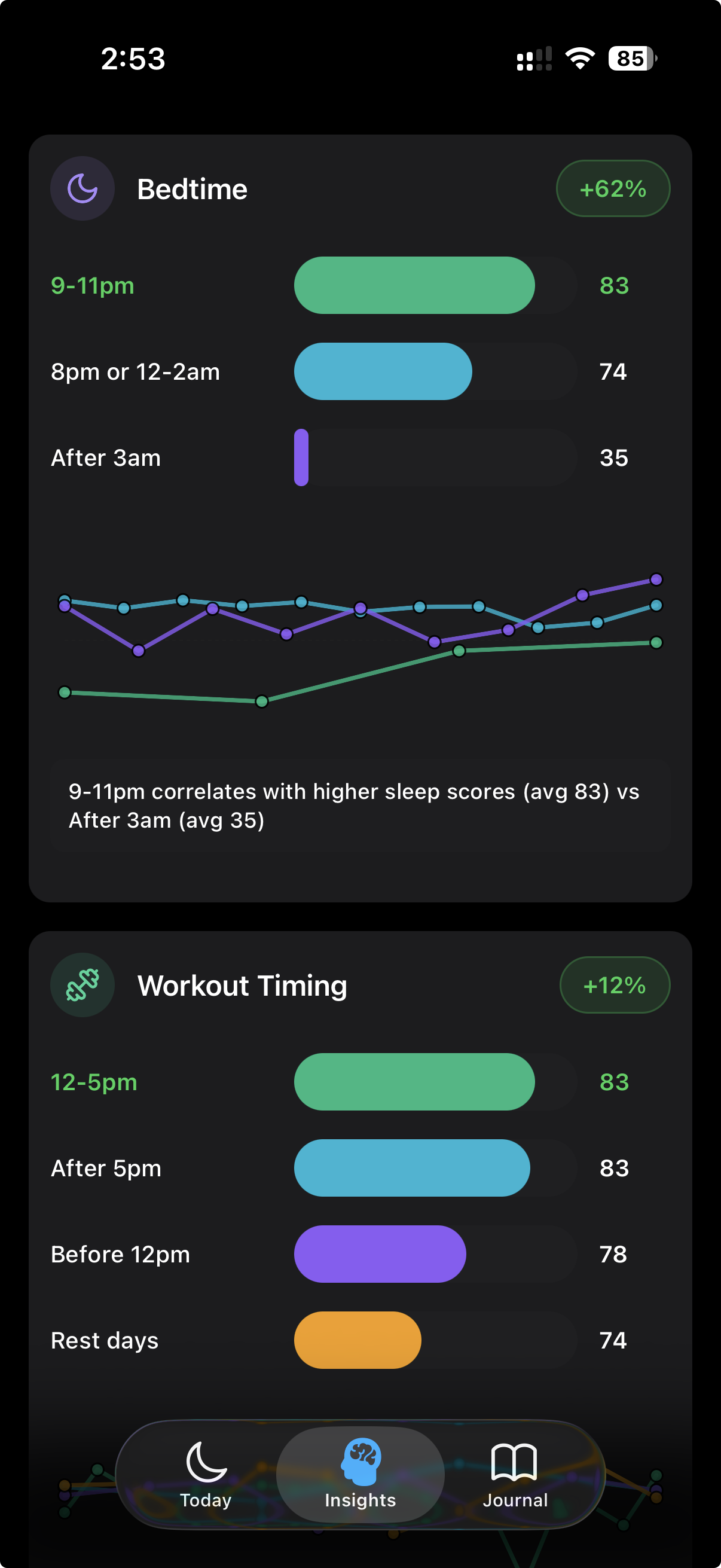
Apple Watch detects daytime sleep events and logs them alongside your main sleep period. Reverie reads both. When you have a nap on a given day, Reverie adjusts its expectations for that night's sleep, and when it scores the night, it shows you whether the nap helped, hurt, or had no measurable effect.
What Reverie Shows You About Your Naps
Reverie connects your nap behavior to your night-sleep outcomes so you can decide whether naps are a net positive for your schedule or something to cut.
- • Automatic nap detection from Apple Watch sleep records
- • Nap length and timing shown on the daily timeline
- • Impact on that night's sleep score, onset latency, and deep sleep
- • Weekly patterns so you can see if your napping habits help or hurt
References
- Hayashi M, Watanabe M, Hori T. "The effects of a 20 min nap in the mid-afternoon on mood, performance and EEG activity." Clin Neurophysiol. 1999;110(2):272-279. Source
- Brooks A, Lack L. "A brief afternoon nap following nocturnal sleep restriction: which nap duration is most recuperative?" Sleep. 2006;29(6):831-840. Source
- Hayashi M, Masuda A, Hori T. "The alerting effects of caffeine, bright light and face washing after a short daytime nap." Clin Neurophysiol. 2003;114(12):2268-2278. Source
- Faraut B, et al. "Napping: A public health issue. From epidemiological to laboratory studies." Sleep Med Rev. 2017;35:85-100. Source
- Milner CE, Cote KA. "Benefits of napping in healthy adults: impact of nap length, time of day, age, and experience with napping." J Sleep Res. 2009;18(2):272-281. Source
Related Articles
The 90-Minute Sleep Cycle
Why the 90-minute nap works and the 60-minute nap does not — it is all about completing the cycle.
Sleep Debt Explained
How strategic naps fit into paying down a sleep deficit — and when they make the deficit worse.
See How Your Naps Affect Your Sleep
Join our beta program and get a clear view of how each nap changes the night that follows. Reverie turns your Apple Watch data into answers you can act on.
Free beta access. Shape the product. First to get updates. Requires Apple Watch.
Written by the Reverie Team
Based on sleep research and scientific studies