Sleep and Weight Loss: Why Poor Sleep Stalls Your Metabolism
Most weight-loss advice focuses on calories and exercise, and ignores the single variable that decides whether your body will actually burn fat instead of muscle: how much you slept last night. Sleep sits upstream of hunger, cravings, insulin, and the kind of tissue your body chooses to lose.
Key Insight: A 2010 randomized trial showed that dieters who slept 8.5 hours lost 55% more body fat than those sleeping 5.5 hours — despite eating the same calories. Short sleep specifically burns muscle instead of fat.
How Sleep Controls the Hormones of Hunger
Appetite is not a willpower problem. It is a hormonal signal, governed by two molecules that rise and fall depending on how well you slept. Leptin, produced by fat cells, tells your brain that you have enough energy stored and can stop eating. Ghrelin, produced in the stomach, tells your brain that you are hungry and need to find food.
In a tightly controlled laboratory study, Spiegel and colleagues put healthy young men through two nights of 4 hours in bed and compared their hormone profiles to nights of 10 hours in bed. After short sleep, leptin levels fell by 18% and ghrelin levels rose by 28%. Subjective hunger climbed by 24%, and the men specifically craved calorie-dense foods — sweets, salty snacks, and starchy carbohydrates. They were not hungrier for vegetables.
That roughly 15% gap between the two appetite signals compounds across a week. If you sleep poorly every weeknight, your brain is spending five out of seven days receiving a false hunger signal. You are not imagining that it is harder to stay on a diet when you are tired — your hormones are genuinely pointing you toward food you do not need.
The Two Hormones of Hunger
The Insulin Resistance Connection
Insulin is the hormone that lets your cells absorb glucose from the blood. When insulin works well, your body stores fuel where it belongs and keeps blood sugar stable. When insulin signaling breaks down, glucose stays in the blood, your pancreas overproduces insulin, and your body shifts into fat-storage mode.
In a striking 2010 study, Donga and colleagues showed that just one night of 4 hours of sleep reduced insulin sensitivity by roughly 30% across multiple metabolic pathways — in young, healthy adults with no prior metabolic disease. The change was large enough to push their insulin profile into the range typically seen in prediabetes.
That is a big deal when you are trying to lose weight. Insulin resistance means your body stores calories more aggressively as fat and releases stored fat more reluctantly. You end up eating less but seeing the scale refuse to move, because your hormonal environment has shifted toward storage.
Why Short Sleepers Eat More (and Worse)
The hormone story predicts that tired people should eat more. Free-living studies confirm it — and the extra calories are not small. Markwald and colleagues measured food intake in a controlled environment and found that adults who slept about 5 hours a night consumed roughly 300 extra calories per day compared to the same people on adequate sleep. That is a pound of fat every two weeks, from nothing but sleep loss.
The pattern of extra eating matters as much as the amount. Short sleepers do not reach for broccoli. They reach for ice cream, chips, and bread. Functional MRI studies show that sleep deprivation dampens activity in the prefrontal cortex — the part of the brain that evaluates long-term consequences — while increasing activity in the amygdala and reward centers that respond to high-calorie food.
Weakened Prefrontal Control
After a short night, the brain region that says "you do not actually need a cookie" works less efficiently. You still know the cookie is not a good choice; you just have a harder time acting on that knowledge.
Amplified Reward Response
The same donut triggers a stronger dopamine response in a sleep-deprived brain than in a rested one. Food tastes better and feels more rewarding when you are tired — a dangerous combination when you are trying to lose weight.
Longer Eating Windows
Staying up late adds hours during which you could be eating. Late-night calories also hit a circadian low point for insulin sensitivity, so the same food provokes a larger blood-sugar spike at midnight than at noon.
Population-Level BMI Effects
Taheri and colleagues, using data from the Wisconsin Sleep Cohort, found that people sleeping 5 hours per night had 15.5% higher ghrelin, 15.5% lower leptin, and an average BMI 3.6% higher than people sleeping 8 hours — after controlling for age, sex, and activity.
Fat Loss vs Muscle Loss: The Sleep Difference
The most important study on sleep and weight loss is almost never quoted correctly. Nedeltcheva and colleagues, in 2010, ran a randomized crossover trial where overweight adults were placed on identical calorie-restricted diets. The only variable changed between conditions was sleep: 8.5 hours in bed versus 5.5 hours in bed.
Both groups lost the same total weight. That part surprises no one. But when the researchers used body composition analysis to separate fat loss from lean-mass loss, the difference was dramatic. The 8.5-hour group lost predominantly fat. The 5.5-hour group lost predominantly muscle. The longer sleepers lost 55% more fat than the short sleepers — from the same diet.
The mechanism is partly cortisol and partly growth hormone. Short sleep raises evening cortisol, which promotes muscle breakdown, and reduces the nocturnal growth-hormone pulse, which normally protects muscle during a calorie deficit. Your body has to give up something to cover the energy gap, and without enough sleep, it raids lean tissue first.
8.5 hours in bed
Same diet. More fat loss. Muscle largely preserved. Lower hunger. Better adherence to the diet across the full trial.
5.5 hours in bed
Same diet. Same weight loss on the scale — but most of it was muscle. Higher hunger. Worse adherence. The scale lied about progress.
Practical Strategies to Protect Both
You cannot out-diet poor sleep. If weight loss has stalled, fix the sleep before changing the macros again. These are the highest-leverage habits for protecting both your sleep and your body composition at the same time.
Strategies That Protect Fat Loss
- Protein-forward last meal.30 to 40g of protein in your final meal helps preserve lean mass overnight and blunts next-morning hunger without adding many calories.
- Consistent bedtime.Same sleep and wake time every day, including weekends. Circadian consistency normalizes leptin, ghrelin, and insulin across the week.
- Caffeine cutoff by 2 PM.Caffeine has a 6-hour half-life. Afternoon coffee reduces deep sleep by 20 to 30% even when you fall asleep on time.
- Do not nap when weight loss stalls.Daytime naps reduce the homeostatic drive for night-time sleep, which is exactly the pressure you need to get a full, deep-sleep-rich first half of the night.
- Alcohol audit.Even two drinks with dinner collapses the REM-heavy second half of the night and raises cortisol. It is the single most common reason a "good" diet produces muscle loss.
How Reverie Tracks Sleep Against Weight Goals
The hardest part of linking sleep to weight loss is seeing the connection in your own data. The effects compound over weeks. A single bad night rarely moves the scale the next morning, but a month of 6-hour nights can stall a diet that was working at 8.
Apple Health stores your sleep and your weight, but it does not connect them. You cannot look at the last 30 days and ask "were my best weight-loss weeks also my best sleep weeks?"
How Reverie Ties Sleep to Your Goals
Reverie turns your Apple Watch sleep data into a weekly score and then correlates that score with the habits you log — eating, caffeine, alcohol, training. You can see, in one view, whether your sleep is actually supporting your weight goal or quietly sabotaging it.
- • Weekly sleep score trends, side by side with your habits
- • Automatic correlations between alcohol, caffeine, and sleep quality
- • Surface the habits most linked to your best nights
- • Track sleep consistency as a leading indicator for metabolism
References
- Nedeltcheva AV, Kilkus JM, Imperial J, Schoeller DA, Penev PD. "Insufficient sleep undermines dietary efforts to reduce adiposity." Ann Intern Med. 2010;153(7):435-441. Source
- Spiegel K, Tasali E, Penev P, Van Cauter E. "Brief communication: Sleep curtailment in healthy young men is associated with decreased leptin levels, elevated ghrelin levels, and increased hunger and appetite." Ann Intern Med. 2004;141(11):846-850. Source
- Markwald RR, et al. "Impact of insufficient sleep on total daily energy expenditure, food intake, and weight gain." Proc Natl Acad Sci USA. 2013;110(14):5695-5700. Source
- Taheri S, Lin L, Austin D, Young T, Mignot E. "Short sleep duration is associated with reduced leptin, elevated ghrelin, and increased body mass index." PLoS Med. 2004;1(3):e62. Source
- Donga E, et al. "A single night of partial sleep deprivation induces insulin resistance in multiple metabolic pathways in healthy subjects." J Clin Endocrinol Metab. 2010;95(6):2963-2968. Source
Related Articles
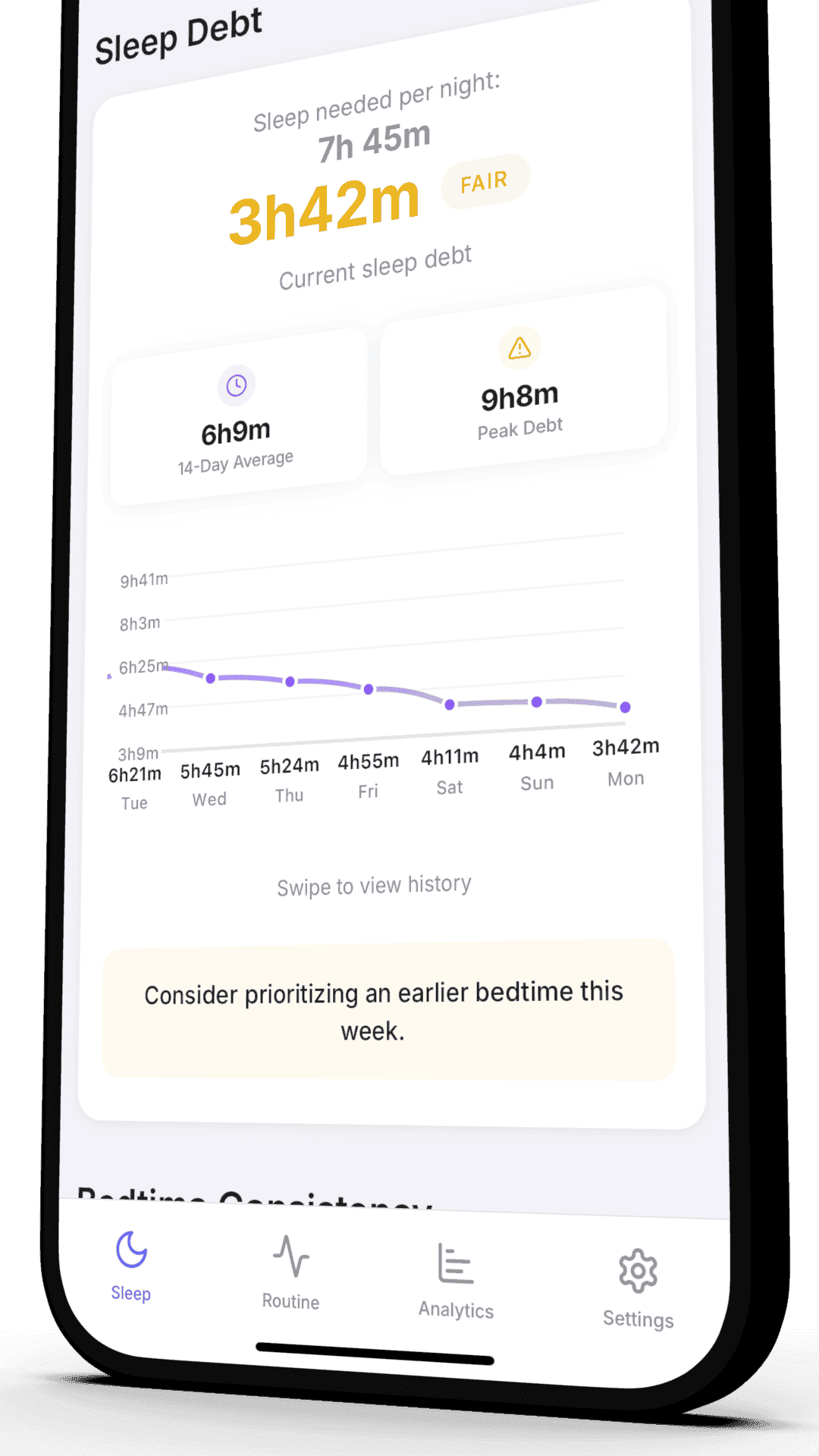
Understanding Sleep Debt
How accumulated sleep loss affects every metabolic system you care about.
Exercise and Sleep
How training interacts with sleep and why timing your workouts matters.
Track Sleep Against Your Weight Goals
Join our beta program and see how your sleep lines up with your weight-loss progress. Reverie turns your Apple Watch data into a readable score with habit context.
Free beta access. Shape the product. First to get updates. Requires Apple Watch.
Written by the Reverie Team
Based on sleep research and scientific studies