HRV During Sleep: What Is Normal on Apple Watch?
Heart rate variability is one of the most useful numbers your Apple Watch tracks, and the version it captures while you sleep is the cleanest read you can get. But what counts as "normal" depends on your age, your fitness, and which sleep stage you're in.
Key Insight: A typical adult sleep HRV (RMSSD) sits between roughly 18 and 76 ms. Your own number matters less than the trend. A sudden drop of 20 percent below your baseline almost always means stress, alcohol, or illness.
What HRV Actually Measures
Heart rate variability is the tiny variation in time between one heartbeat and the next. Your heart isn't a metronome. Even when your average rate is 60 beats per minute, the gap between any two beats might be 980 ms, then 1,020 ms, then 990 ms. That variation is HRV.
Higher variation is generally a good sign. It means your nervous system is flexible — your parasympathetic (rest-and-digest) and sympathetic (fight-or-flight) branches are talking to each other smoothly. Low, flat variation suggests your body is locked into one mode, usually because of stress, illness, alcohol, or hard training.
Apple Watch reports HRV using a metric called RMSSD (root mean square of successive differences). It's the standard time-domain measure used in most consumer wearables and in clinical research. The number is in milliseconds. A higher number is, broadly, better.
Why Sleep HRV Is the Cleanest Read
How HRV Shifts by Sleep Stage
Your HRV does not stay flat across the night. It rides up and down with your sleep stages, mirroring the wave pattern of parasympathetic and sympathetic activity.
Deep sleep (N3): This is where HRV peaks. Your parasympathetic system is fully in charge. Heart rate is at its lowest, breathing is slow and steady, and beat-to-beat variation is high. If you want to see your "best" HRV of the night, look at your deep sleep windows.
Light sleep (N1, N2): HRV is moderate. The parasympathetic system is engaged but not fully dominant. This is the bulk of your night, so most of your average sleep HRV comes from here.
REM sleep: Surprisingly, HRV often drops here. Your brain is highly active during REM, your heart rate jumps around, and your sympathetic system pulses on and off. A 1995 paper in Circulation documented this pattern: HRV measures like RMSSD are typically lower in REM than in deep sleep.
That's why a single number for "sleep HRV" hides a lot of detail. If your night was REM-heavy (common in the second half of sleep), your average HRV will look lower than it would on a deep-heavy night, even if both nights were healthy. For more on how stages combine, see our guide to 90-minute sleep cycles.
What Counts as a Normal Number
The most-cited population reference for HRV norms is Shaffer and Ginsberg, 2017, in Frontiers in Public Health. Their review pooled data from healthy adults and reported that resting RMSSD spans a wide range — roughly 19 to 75 ms — depending on age, sex, and fitness. Sleep HRV tends to run a bit higher than waking resting HRV, since the parasympathetic system is more active.
A few rough benchmarks for sleep RMSSD on a wrist wearable:
Approximate Sleep HRV Ranges by Age
Ranges are approximate and based on aggregated data from population studies. Individual values vary widely.
The biggest mistake people make is comparing their HRV to someone else's. A 35-year-old endurance athlete might sit at 110 ms. A perfectly healthy 55-year-old might sit at 28 ms. Both numbers are fine for those people. What matters is what your number does over the next 30 days.
What Suppresses Overnight HRV
A handful of inputs reliably crush sleep HRV. If your number drops, it's almost always one of these.
Alcohol
The single biggest hit you can take in one night. A 2018 study by Pietilä and colleagues in JMIR Mental Health tracked 42,000 people and found that alcohol cut HRV-derived recovery by 9 percent at low doses, 24 percent at moderate doses, and 39 percent at high doses. See our deep dive on alcohol and sleep.
Late or Hard Workouts
Intense exercise inside 3 hours of bedtime keeps your sympathetic system elevated. HRV in the first half of the night drops noticeably. See exercise and sleep.
Illness
A 15 to 30 percent drop in your overnight HRV often shows up 24 to 48 hours before you feel sick. Your immune system is firing, and your sympathetic system rises with it.
Stress
Acute stress (a fight, a deadline, bad news) can drop HRV that night. Chronic stress is more dangerous — it lowers your baseline for weeks and is a known risk factor for cardiovascular disease.
Late Heavy Meals
Digestion in the first half of sleep raises heart rate and reduces variability. Eating within 2 hours of bed reliably lowers HRV.
Dehydration
Even mild dehydration constricts blood vessels and forces your heart to work harder. HRV drops as a result.
How Apple Watch Measures HRV
Apple Watch uses its optical heart sensor — the green and infrared LEDs on the back — to detect blood-flow pulses at your wrist. From those pulses, it estimates the time between heartbeats and computes RMSSD over short windows, usually a minute or two at a time.
A clinical-grade ECG (the gold standard) detects the actual electrical R-wave of each heartbeat. Optical sensors are slightly noisier — they can miss beats during motion, and they smooth over very fast variations. Validation studies show that Apple Watch HRV correlates well with ECG at rest, but the absolute number tends to be a few milliseconds lower.
The takeaway: don't obsess over the precise number. Use the trend line. If your 30-day average is 42 ms and tonight you got 28 ms, that's a meaningful 33 percent drop — regardless of what a research-grade ECG would have read.
How to Improve Your Sleep HRV
You can't force HRV up. You create the conditions for the parasympathetic system to take over, and the number rises on its own.
Habits That Reliably Raise Sleep HRV
- Cut evening alcohol.Even one or two drinks suppresses HRV for the entire night. This is the single biggest lever for most adults.
- Train aerobic capacity.Zone 2 work — 30 to 60 minutes of easy cardio, 3 to 4 times a week — raises baseline HRV over weeks.
- Stop eating 3 hours before bed.Lets digestion finish before sleep onset, so HRV can rise during the first cycle.
- Cool the bedroom.65 to 68°F lets core temperature drop, which engages the parasympathetic system.
- Slow your breathing before bed.5 minutes of slow breathing (4-second in, 6-second out) shifts your nervous system before sleep onset and is one of the few habits with measurable acute effect on HRV.
- Sleep more, on a regular schedule.Total sleep duration and consistent timing both predict higher HRV in long-term cohort studies.
What Reverie Does With HRV
Apple Health stores your HRV but shows it as a list of timestamped readings, with no link to your sleep stages or daily habits. You can see the number but you can't see why it changed.
How Reverie Surfaces HRV Patterns
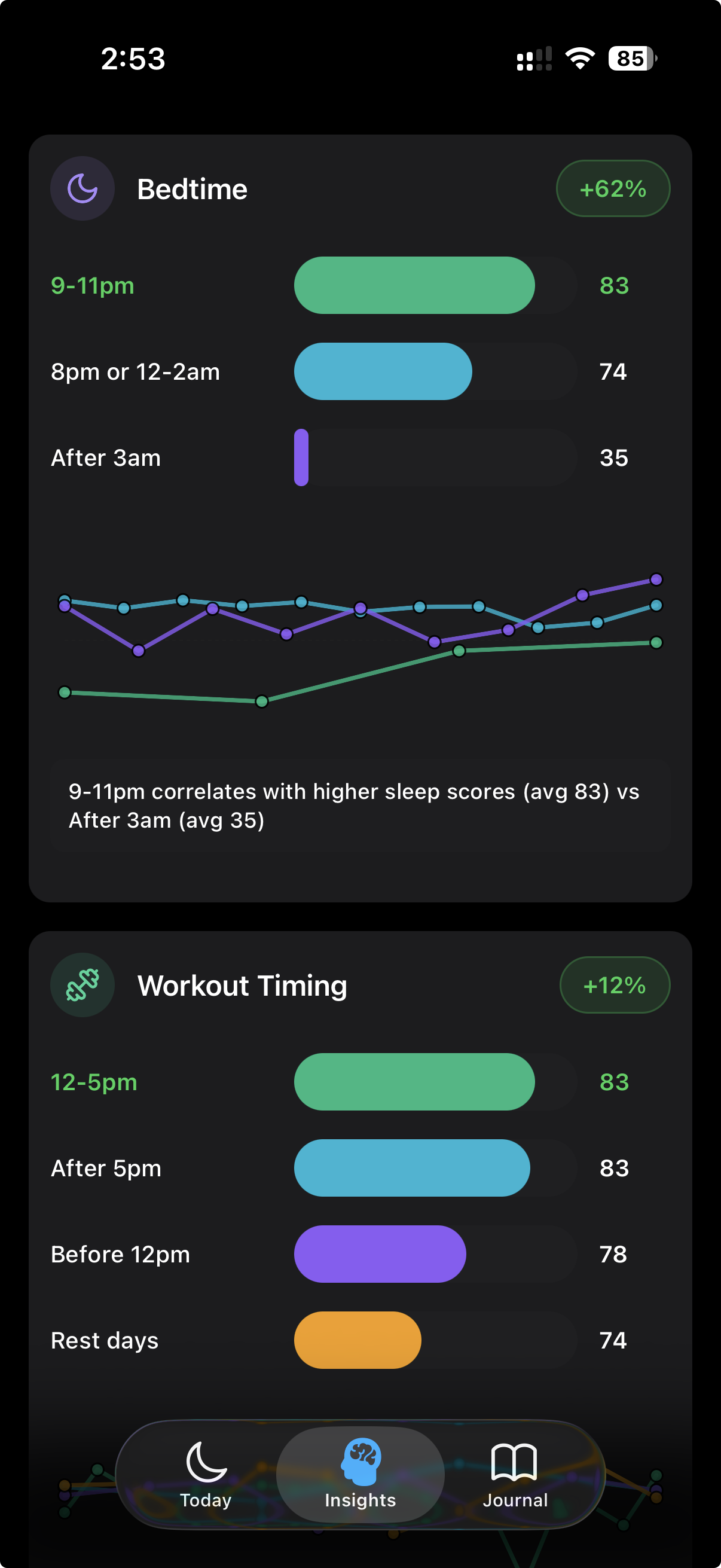
Reverie pulls your overnight HRV from Apple Health and lays it next to your sleep stages, your sleep score, your habit log, and your weekly trend. You can see at a glance which habits push your HRV up and which crash it.
- • Track your 30-day HRV baseline so you know what "low" actually means for you
- • See how alcohol, late workouts, and stress show up in tonight's number
- • Spot illness early — a 20 percent HRV drop often precedes symptoms
- • Cross-reference HRV with sleep score, REM, and deep sleep on the same chart
References
- Shaffer F, Ginsberg JP. "An Overview of Heart Rate Variability Metrics and Norms." Frontiers in Public Health. 2017;5:258. Source
- Vanoli E, Adamson PB, Ba-Lin, et al. "Heart rate variability during specific sleep stages. A comparison of healthy subjects with patients after myocardial infarction." Circulation. 1995;91(7):1918-1922. PubMed
- Pietilä J, Helander E, Korhonen I, et al. "Acute Effect of Alcohol Intake on Cardiovascular Autonomic Regulation During the First Hours of Sleep in a Large Real-World Sample of Finnish Employees: Observational Study." JMIR Mental Health. 2018;5(1):e23. PubMed
- Boudreau P, Yeh WH, Dumont GA, Boivin DB. "Circadian Variation of Heart Rate Variability Across Sleep Stages." Sleep. 2013;36(12):1919-1928. PMC
- Herzig D, Eser P, Omlin X, et al. "Reproducibility of Heart Rate Variability Is Parameter and Sleep Stage Dependent." Frontiers in Physiology. 2018;8:1100. Source
- Task Force of the European Society of Cardiology and the North American Society of Pacing and Electrophysiology. "Heart rate variability: standards of measurement, physiological interpretation, and clinical use." Circulation. 1996;93(5):1043-1065. PubMed
Related Articles
Apple Watch Sleep Score Explained
How Apple's score works and where HRV fits into the bigger picture.
Exercise and Sleep
When to work out for higher HRV, deeper sleep, and better recovery.
See What's Driving Your HRV
Reverie correlates your overnight HRV with alcohol, exercise, bedtime, and sleep stages — so you can stop guessing why tonight's number is low.
Free beta access. Shape the product. First to get updates. Requires Apple Watch.
Written by the Reverie Team
Based on peer-reviewed cardiovascular and sleep research