Sleep Cycle App Review 2026: Worth It vs Apple Watch?
Sleep Cycle was tracking sleep before most of us had smartwatches. It uses your iPhone's microphone and motion sensors to estimate when you are asleep, awake, or moving — no wearable required. Here is an honest look at how it holds up in 2026.
Key Insight: Sleep Cycle is the best sleep tracker for people who do not own a wearable. If you have an Apple Watch, the Watch plus a dedicated app will give you more accurate stage-level data.
How Sleep Cycle Actually Works
Sleep Cycle, made by Swedish developer Northcube, has been on the App Store since 2009. It was one of the first apps to popularize the idea of a "smart alarm" that wakes you during light sleep.
The app has two ways of tracking your sleep, and you can pick one in settings:
Microphone mode (the default)
Your phone sits on your nightstand or charger. Sleep Cycle listens for tiny movements, breathing patterns, and snoring through the microphone. It analyzes the sound on-device and never uploads raw audio. From those sound patterns it builds a hypnogram — a chart of when you were in light, deep, or awake states.
Accelerometer mode
You place the phone on your mattress (corner of the bed, charging cable plugged in). The accelerometer detects bed motion. It is less common now because most people prefer not to sleep next to their phone.
In both modes, the app sets a 30-minute window before your alarm and tries to wake you when it detects light sleep within that window. If it does not catch a light-sleep moment, it falls back to the alarm time you set. The reason this works at all comes down to how 90-minute sleep cycles unfold across the night — light sleep and brief wake moments are common at the end of each cycle.
Free vs Premium in April 2026
Sleep Cycle has a free tier and a Premium subscription. Pricing has been inching up, so verify on the App Store before you commit.
Free
- Basic sleep tracking
- Smart alarm with 30-minute wake window
- Sleep quality score
- Limited night history
Premium
Around $59.99/year in the US in April 2026, up from $29.99 a few years ago.
- Snore detection and recording playback
- Sleep notes and habit tagging
- Long-term trends and statistics
- Apple Health sync
- Sleep stories, soundscapes, Philips Hue integration
- Data export
The price hike is one of the most common complaints in App Store reviews from 2025 onward. Long-time users have flagged that core features they used to get for less are now behind the higher tier.
Accuracy Without a Wearable
The honest answer: Sleep Cycle is reasonable at telling you roughly when you fell asleep and when you woke up. It is not as good at scoring individual sleep stages.
Sound and bed-motion data simply do not contain the same information as wrist-worn sensors that combine heart rate, accelerometer, and photoplethysmography. Roberts et al. (2020), in a wearables validation study published in Sleep, showed that even high-end consumer trackers struggle to perfectly match polysomnography on stage-level scoring. A microphone-only tracker has an even harder job.
That said, for total sleep duration and rough sleep efficiency — the percentage of time in bed actually spent asleep — Sleep Cycle does fine for casual use. If you want a primer on this metric, see our explainer on sleep efficiency.
Research Spotlight
Bhat et al. (2015), in the Journal of Clinical Sleep Medicine, compared a smartphone sleep app to polysomnography in adults. They found that sound and motion-based apps could approximate total sleep time but had low accuracy for staging — a finding that still applies to non-wearable trackers.
The smart alarm itself is the best-tested feature, and many users genuinely report waking up less groggy when it is on. Whether that is the algorithm finding light sleep or just the placebo of expecting to wake up gently is hard to say — but the experience is real for a lot of people.
What Sleep Cycle Does Well
No wearable needed
If you do not own an Apple Watch or do not want to sleep with one on, this is the cleanest option.
The smart alarm is genuinely useful
A 30-minute wake window often catches a lighter moment and avoids the worst grogginess.
Snoring insights
Snore detection (Premium) records short clips so you can hear how often and how loudly you snore.
Long history of refinement
15+ years of updates means the basics are stable and the UI is polished.
Where Apple Watch Plus an App Pulls Ahead
If you already own an Apple Watch — even an older Series 4 or SE — the gap with Sleep Cycle is real and worth understanding.
Heart rate signals
Sleep Cycle has no heart rate data. Apple Watch records continuous heart rate, dipping rate, and HRV, all of which give a more reliable picture of your physiological recovery overnight.
Sleep stages
Apple Watch (Series 4+, watchOS 9+) estimates light, deep, and REM sleep using motion and heart rate together. Sleep Cycle's stage estimates from sound alone are noisier.
Sleep with a partner
A microphone in a shared bed picks up the other person's snoring, breathing, and movement. Sleep Cycle has filters for this, but a wrist-worn sensor is naturally immune.
Sleep score and analytics
Apple Watch combined with apps gives you cleaner trend analysis. Our overview of what counts as a good sleep score covers what these numbers mean across platforms.
If you want a deep dive on the Watch side, see our complete guide to Apple Watch sleep tracking and our breakdown of sleep tracking app vs Apple Health.
Privacy: A Microphone in Your Bedroom
Putting a phone microphone next to your bed every night is, fairly, something to think about. Northcube's published privacy policy says the audio is processed on-device and not uploaded as raw recordings. The app does store snore clips locally on your phone if you have Premium, and you can play them back from the app.
In practice, iOS shows a microphone-active indicator (the orange dot) whenever the app is listening, and you control microphone permission in Settings. If a phone-based microphone tracker still bothers you, the accelerometer-only mode avoids the microphone entirely, though accuracy drops further.
As always, read the current privacy policy yourself before you commit — policies change.
Who Sleep Cycle Is For
Good fit if you:
- Do not have a wearable and do not plan to buy one
- Mainly want a better wake-up experience
- Are curious about your snoring
- Sleep alone, or your partner sleeps quietly
Probably not for you if:
- You already wear an Apple Watch to bed
- You want HRV, deep sleep, or REM with research-grade signals
- You are uncomfortable with a microphone listening overnight
- You do not want a $60/year subscription
Where Reverie Fits
Reverie is built around Apple Watch and Apple Health, so it is not a direct replacement for Sleep Cycle if you do not own a Watch. If you do own one, Reverie reads the same sleep data Apple is already collecting and adds the missing piece: how your daily habits (caffeine, alcohol, exercise, stress, screen time) line up with your good and bad nights.
Sleep Cycle gives you a hypnogram and a wake-up nudge. Reverie tries to answer the harder question of why a particular week looked the way it did. They are different tools, not direct competitors.
Bottom line
Sleep Cycle in 2026 is still the best sleep tracker for people without a wearable, especially if you mostly want a smarter alarm and snore feedback. If you already have an Apple Watch, you will get more useful data from the Watch plus a dedicated app — and a habit-aware tool like Reverie can help you turn that data into changes.
References
- Roberts DM, Schade MM, Mathew GM, Gartenberg D, Buxton OM. "Detecting sleep using heart rate and motion data from multisensor consumer-grade wearables." Sleep. 2020;43(7):zsaa045. PubMed
- Chinoy ED, et al. "Performance of seven consumer sleep-tracking devices compared with polysomnography." Sleep. 2021;44(5):zsaa291. PubMed
- Bhat S, et al. "Is There a Clinical Role for Smartphone Sleep Apps? Comparison of Sleep Cycle Detection by a Smartphone Application to Polysomnography." Journal of Clinical Sleep Medicine. 2015;11(7):709-715. PubMed
- Sleep Cycle. "Sleep Cycle Freemium vs. Premium Features." Sleep Cycle Support. Source
- TechRadar. "Sleep Cycle review." techradar.com. TechRadar
- National Sleep Foundation. "Sleep Tracking Technology." sleepfoundation.org. Source
Related Articles
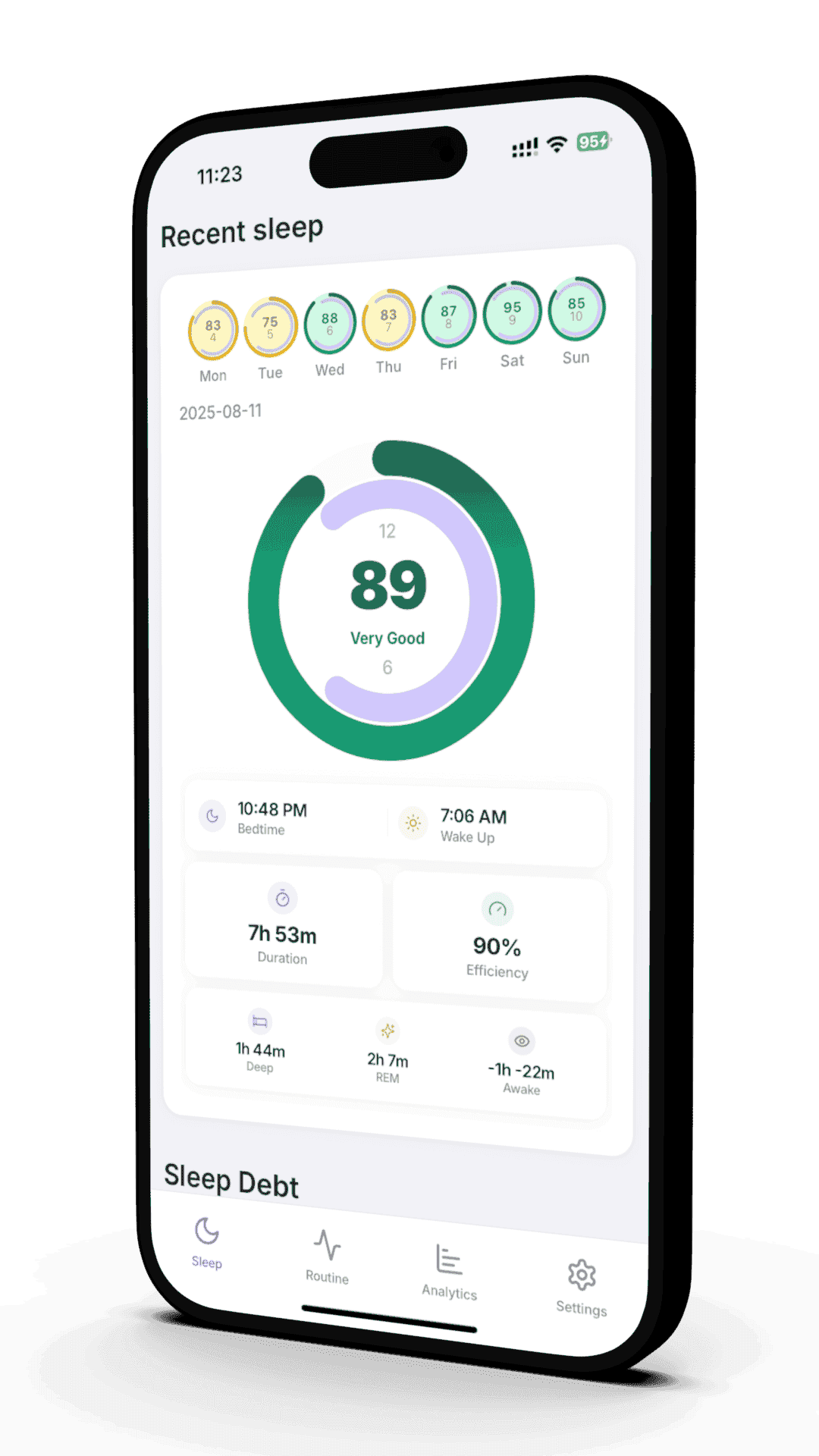
Complete Guide to Apple Watch Sleep Tracking
Setup, accuracy, and what the Watch can do that a phone-only app cannot.
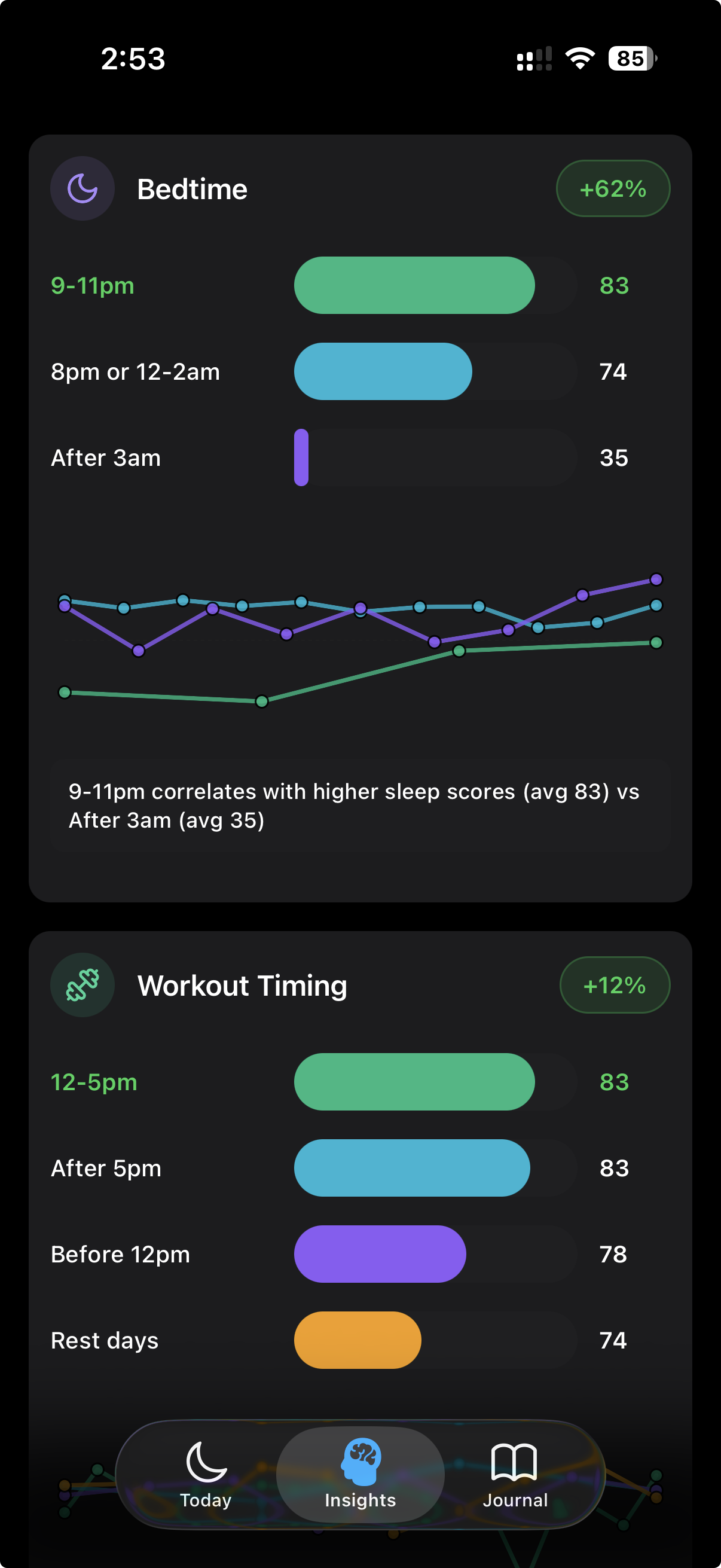
What Is a Good Sleep Score?
How to read sleep scores across apps and what numbers actually matter.
Pair Your Sleep Data With Real Habits
If you already track sleep — with Sleep Cycle, Apple Watch, or anything else — Reverie connects those nights to the habits that shaped them. Free during beta.
Free beta access. Shape the product. First to get updates. Requires Apple Watch.
Written by the Reverie Team
Based on hands-on use and validation research