How to Fall Asleep Faster: 9 Science-Backed Tips
You're lying in bed, eyes wide open, watching the minutes tick by. The harder you try to sleep, the more awake you feel. Here's the good news: there are real, research-backed tactics that can shrink your sleep latency from 30 minutes to under 15.
Key Insight: The fastest sleepers don't fight to fall asleep — they create the right conditions and let sleep come. Cooling the room, slowing your breath, and quieting your thoughts work because they signal your nervous system that it's safe to power down.
Why Trying Harder Backfires
Sleep is one of the few things in life that gets harder the more you push. The act of trying to sleep activates your sympathetic nervous system — the same fight-or-flight machinery that keeps you up. Researchers call this "sleep effort," and it's a core driver of insomnia.
A normal, healthy sleep latency is about 10 to 20 minutes. If you're routinely taking more than 30 minutes to fall asleep, the tactics below can help. If you're falling asleep in under 5 minutes, you're probably sleep deprived — read our piece on sleep debt first.
Each of the nine tactics below targets a different barrier to sleep onset: body temperature, racing thoughts, anxiety, muscle tension, light exposure, schedule, or stimulants. Pick two or three to start. Stacking them works better than relying on any single trick.
1. Cool the Bedroom to 65–68°F
Your core body temperature has to drop by about 1°F for sleep to begin. A warm room blocks that drop. The Sleep Foundation and most sleep medicine clinics recommend a bedroom between 65 and 68°F (18–20°C) for the easiest sleep onset.
A 2023 PubMed study tracking 50 older adults across 11,000 nights found sleep efficiency dropped 5 to 10 percent when bedroom temperature climbed from 77°F to 86°F. Cooler nights produced longer, more restful sleep.
If your thermostat won't go that low, run a fan, kick a foot out from under the covers, or take a warm shower 90 minutes before bed. The shower trick works because the warm water pulls blood to your skin, and once you step out, your core temperature drops faster than usual. For more on this, read our bedroom temperature guide.
Best for: people who feel hot or sweaty in bed, or who live in warm climates without air conditioning.
2. The Cognitive Shuffle (Beaudoin's Method)
The cognitive shuffle was developed by cognitive scientist Dr. Luc Beaudoin at Simon Fraser University. The idea: pick a random, neutral word — say, "candle" — and visualize objects starting with each letter (cat, ant, nest, dog, lemon, eggs). Then pick another word and do it again.
Why it works: your brain interprets coherent, goal-directed thinking as a reason to stay awake. Random, scattered images feel like the dream-like jumble of light sleep, so the brain stops alerting and lets you drift off.
Beaudoin's 2016 trial of 154 university students found the cognitive shuffle was as effective as structured problem-solving at lowering pre-sleep arousal and improving sleep quality. It works especially well for people whose minds race at bedtime.
Best for: people whose brain won't stop running through tomorrow's to-do list.
3. 4-7-8 Breathing
Created by Dr. Andrew Weil, the 4-7-8 method is a slow, paced breathing pattern: inhale through your nose for 4 seconds, hold for 7 seconds, exhale through your mouth for 8 seconds. Repeat four times.
The long exhale activates your vagus nerve and shifts you into the parasympathetic "rest and digest" mode. Heart rate slows. Blood pressure drops. Your body reads the signal as safety.
A 2022 study in Physiological Reports found 4-7-8 breathing significantly increased high-frequency heart rate variability (a marker of parasympathetic activation) and lowered systolic blood pressure. Other trials have shown sleep latency dropping from around 38 minutes to under 19 in poor sleepers.
Best for: people who feel physically wired or anxious at bedtime.
4. Paradoxical Intention
This sounds backwards, but it works. Lie in bed and gently try to stay awake. Don't do anything stimulating — just keep your eyes open and tell yourself you'll stay awake a little longer.
The technique was studied extensively by Professor Colin Espie at the University of Glasgow. By removing the pressure to fall asleep, paradoxical intention disarms sleep effort — the very thing that's keeping you up. A 2021 systematic review and meta-analysis on PubMed of 10 trials found paradoxical intention produced large improvements in insomnia symptoms versus passive controls.
Best for: people who feel pressure or frustration about not sleeping. If you've started dreading bedtime, try this.
5. Progressive Muscle Relaxation
Progressive muscle relaxation (PMR) is exactly what it sounds like. Starting at your feet, tense a muscle group hard for 5 seconds, then release for 10 seconds. Move up your body — calves, thighs, glutes, stomach, hands, arms, shoulders, jaw, forehead.
A classic randomized trial (Borkovec & Fowles, 1973) found PMR reduced sleep onset time by about 23 minutes in chronic insomniacs. A 2024 meta-analysis of 31 RCTs and 2,277 patients confirmed PMR significantly improves sleep quality across multiple populations.
The technique works two ways. The contraction-release pattern lowers baseline muscle tension. And focusing on physical sensations interrupts mental rumination.
Best for: people who carry physical tension in their jaw, shoulders, or back.
6. Dim and Warm Light 60 Minutes Before Bed
Bright, blue-rich light tells your brain it's daytime. Your suprachiasmatic nucleus — the master clock — uses retinal light input to time melatonin release. Bright evening light can delay melatonin by an hour or more.
Sixty minutes before bed, dim the overhead lights. Switch to warm-toned lamps under 40 watts. Set your phone to night mode or simply don't use it. For more depth, see our guides on blue light and sleep and screen time before bed.
Best for: people who scroll their phone or watch TV right up until bedtime.
7. The 20-Minute Rule
If you've been lying in bed awake for 20 minutes or more, get up. Leave the bedroom. Sit in dim light and read a boring book (no screens) until you feel sleepy, then go back to bed.
This is called stimulus control, and it's a core part of CBT for insomnia. The goal is to break the mental association between bed and being awake. If you toss and turn in bed for an hour every night, your brain starts to learn that bed equals frustration. The 20-minute rule rewires that connection.
It feels counterintuitive — getting up when you want to sleep — but it's one of the most-studied insomnia treatments in sleep medicine. The trick is to actually do it instead of staying in bed and scrolling.
Best for: people with chronic insomnia who've started to dread bed.
8. Consistent Sleep–Wake Schedule
Your body has an internal clock that anticipates bedtime. If you go to bed at 11 PM on weekdays and 2 AM on weekends, your circadian system never settles. Melatonin doesn't release on time. Sleep latency stretches.
Pick a wake time and stick to it within 30 minutes — even on weekends. Wake time is more powerful than bedtime because morning light anchors the rhythm. Within a week or two, your body will start feeling sleepy at roughly the same time each night.
For the full case on schedule consistency, read our piece on sleep consistency.
Best for: people whose sleep times bounce around by hours from night to night.
9. Caffeine Cutoff 8 Hours Before Bed
Caffeine has a half-life of about 5 to 6 hours. A 2 PM coffee still has a quarter of the caffeine in your system at 10 PM. That's enough to push your sleep latency out by 30 minutes or more.
Caffeine blocks adenosine, the chemical that builds sleep pressure across the day. Less adenosine signaling means less drive to sleep. The 2013 Drake study in the Journal of Clinical Sleep Medicine found that 400 mg of caffeine taken even 6 hours before bed cut total sleep time by more than an hour.
Set a personal caffeine curfew 8 hours before your target bedtime. If you sleep at 11 PM, that's 3 PM. Read our caffeine and sleep guide for the full breakdown, and consider melatonin only if schedule shifts (jet lag, shift work) are the real issue.
Best for: coffee drinkers, soda drinkers, anyone who has caffeine after lunch.
Putting It Together
A Simple 60-Minute Wind-Down Plan
- T-60 min:Dim the lights. Set the bedroom to 67°F. No more caffeine, no more screens.
- T-30 min:Brush teeth, take a warm shower, change into sleep clothes.
- T-10 min:In bed, do four rounds of 4-7-8 breathing.
- T-0:Start the cognitive shuffle. If you're still awake at 20 minutes, get up briefly and reset.
How Reverie Helps
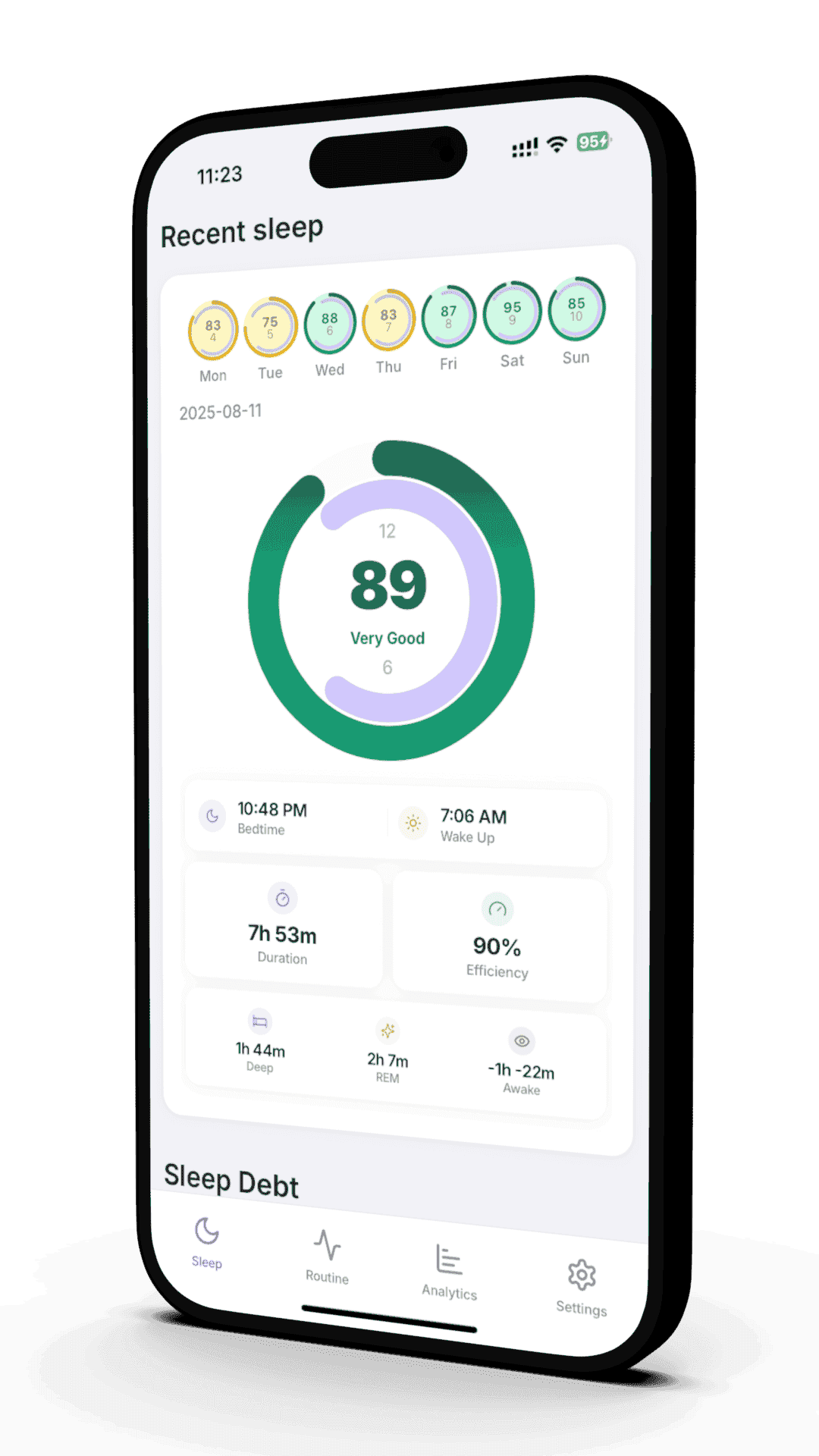
Reverie pulls your sleep latency from your Apple Watch every night and shows you which habits move it. You can see whether the cool room actually helped, whether the late coffee really did push sleep onset out, and whether your wind-down ritual is working.
- • See your sleep latency trend across weeks
- • Tag habits and compare nights side by side
- • Spot which tactic gives you the biggest gain
- • Stop guessing what's actually working
References
- Beaudoin LP, et al. "Serial Diverse Imagining Task: A New Remedy for Bedtime Complaints of Worrying." Conference paper, 2016. Source
- Vierra J, et al. "Effects of sleep deprivation and 4-7-8 breathing control on heart rate variability, blood pressure, blood glucose, and endothelial function in healthy young adults." Physiological Reports. 2022;10(13):e15389. PubMed
- Jansson-Fröjmark M, Alfonsson S, et al. "Paradoxical intention for insomnia: A systematic review and meta-analysis." Journal of Sleep Research. 2022. PubMed
- Baniak LM, et al. "Nighttime ambient temperature and sleep in community-dwelling older adults." Science of the Total Environment. 2023. PubMed
- Liu K, et al. "Progressive muscle relaxation technique improves sleep quality and mental health: A systematic review and meta-analysis of randomized controlled trials." Journal of Psychosomatic Research. 2024. Source
- Drake C, et al. "Caffeine effects on sleep taken 0, 3, or 6 hours before going to bed." Journal of Clinical Sleep Medicine. 2013;9(11):1195-1200. PubMed
Related Articles
Best Bedroom Temperature for Sleep
Why 65–68°F is the sweet spot, and how to hit it without freezing.
Screen Time Before Bed
How phones and TVs delay melatonin and what to do about it.
Track Your Sleep Latency with Reverie
Stop guessing what's working. Join the Reverie beta and see exactly how each tactic moves your sleep latency.
Free beta access. Shape the product. First to get updates. Requires Apple Watch.
Written by the Reverie Team
Based on sleep research and scientific studies